

New Delhi, April 15, 2026: In the heart of Gujarat’s cultural capital, Vadodara, a seemingly routine college performance has spiraled into a national debate on morality, political ethics, and the digital safety of women. What began as a spirited Bollywood dance at Maharaja Sayajirao University (MSU) has transformed into a heartbreaking saga of online harassment, leaving a young student in tears and sparking a fierce political showdown.
The Performance That Sparked a Storm
The incident occurred during “Sanskar Sangam,” a three-day cultural festival organized by the Akhil Bharatiya Vidyarthi Parishad (ABVP) at MSU’s C.C. Mehta Auditorium. Amidst a lineup of traditional programs, an arts student took the stage clad in a saffron saree to perform to the iconic Bollywood track “Dhak Dhak Karne Laga.”
Within hours, clips of the performance flooded social media platforms like X (formerly Twitter) and Instagram. While many initially viewed it as a standard college dance, the tone quickly shifted as the video was co-opted by various groups and influencers.
From Cultural Fest to Political Battlefield
The controversy took a sharp political turn when the National Students’ Union of India (NSUI), the student wing of the Congress party, flagged the video. Labeling the performance as “obscene” and “vulgar,” NSUI leaders launched a scathing attack on the ABVP.
- The Accusation: NSUI President Amar Vaghela stated that MSU is a “temple of education” and that such performances under the banner of a “cultural” event were a stain on the university’s values.
- The Counter-Response: Caught in the crossfire, the ABVP initially distanced itself from the student. They claimed that while 140 students had registered for traditional acts, the student in question was an independent performer who went on stage during a break. ABVP’s Gujarat state general secretary, Devansh Brahmabhatt, later shifted the focus, accusing the NSUI of violating the student’s dignity by circulating her video with “obscene” labels without her consent.
A Student Breaks Down: “Where is the Obscenity?”
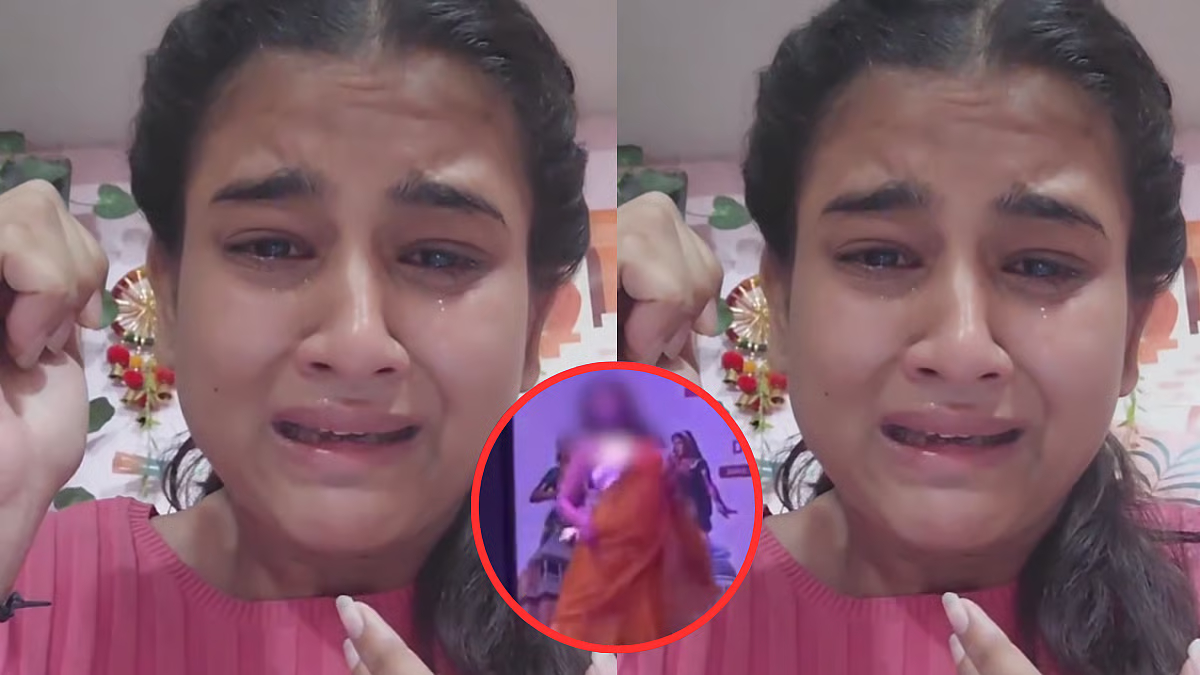
The most harrowing part of this story is the human cost. Following the backlash, the student released a self-recorded video that has since gone viral for all the wrong reasons—it shows a young woman completely broken by the weight of public shaming.
Speaking through tears, the student defended her performance and questioned the logic of her critics:
“I was wearing a simple, normal saree. I was presenting my art on stage. If you are all so ‘cultured,’ then you should stop listening to Bollywood songs as well. I am a normal student; I didn’t think dancing to a song would lead to claims that I have ‘violated traditions.'”
She admitted that her choice of song might have been “a mistake” in hindsight, but she fiercely denied the charge of obscenity. Most poignantly, she alleged that she was being used as a “pawn” in a political game between the NSUI and ABVP, stating that neither party truly cared about her mental well-being.
The Impact of Digital Shaming
The student reported severe mental distress, noting that her social media accounts were targeted and suspended after she tried to tell her side of the story. She highlighted a glaring double standard in the outrage:
- Selective Outrage: She questioned why, in a country with significant socio-economic issues, the collective focus of political organizations was centered on a girl in a saree dancing to a mainstream Bollywood song.
- Privacy Violations: The video was shared widely with political logos and derogatory captions, often without blurring her face or seeking her permission, leading to targeted online harassment.
Key Takeaways from the MSU Controversy
| Aspect | Details |
| Location | Maharaja Sayajirao University (MSU), Vadodara |
| Event | ‘Sanskar Sangam’ Cultural Festival |
| Song Choice | “Dhak Dhak Karne Laga” (Bollywood) |
| Political Involvement | NSUI (Critics) vs. ABVP (Organizers) |
| Student’s Defense | Performed in a saree; no obscenity intended; art was misinterpreted. |
| Current Status | Student has apologized for the song choice while seeking an end to the harassment. |
The Broader Conversation: Art vs. “Sanskari” Values
This incident has reignited a debate on what constitutes “appropriate” culture in Indian educational institutions. Vadodara is often referred to as the Sanskari Nagari (Cultured City), a title that has become a double-edged sword for its residents.
Critics of the backlash argue that the “policing” of a student’s clothing and dance moves is a regression into moral vigilantism. They point out that the song “Dhak Dhak Karne Laga” is a staple of Indian pop culture and that the student’s attire—a saree—is the quintessence of traditional Indian clothing.
On the other hand, traditionalists argue that university platforms should be reserved for “high art” or folk traditions that reflect regional heritage, rather than Bollywood “item” numbers which they perceive as commercial and provocative.
Conclusion: A Call for Empathy
As the dust settles, the Vadodara student’s breakdown serves as a grim reminder of how quickly the internet can turn a moment of joy into a nightmare. Whether or not the song choice was “appropriate” for a specific event is a matter of administrative policy; however, the subsequent public shaming and political weaponization of a student’s image is a matter of ethics.
In an era where every moment is recorded and potentially viral, the MSU incident asks us to pause: Is our “culture” protected by tearing down a student, or is it better served by showing her grace and empathy?
For now, the student remains in a state of distress, asking the public to look past the political logos and see the human being behind the viral video.