

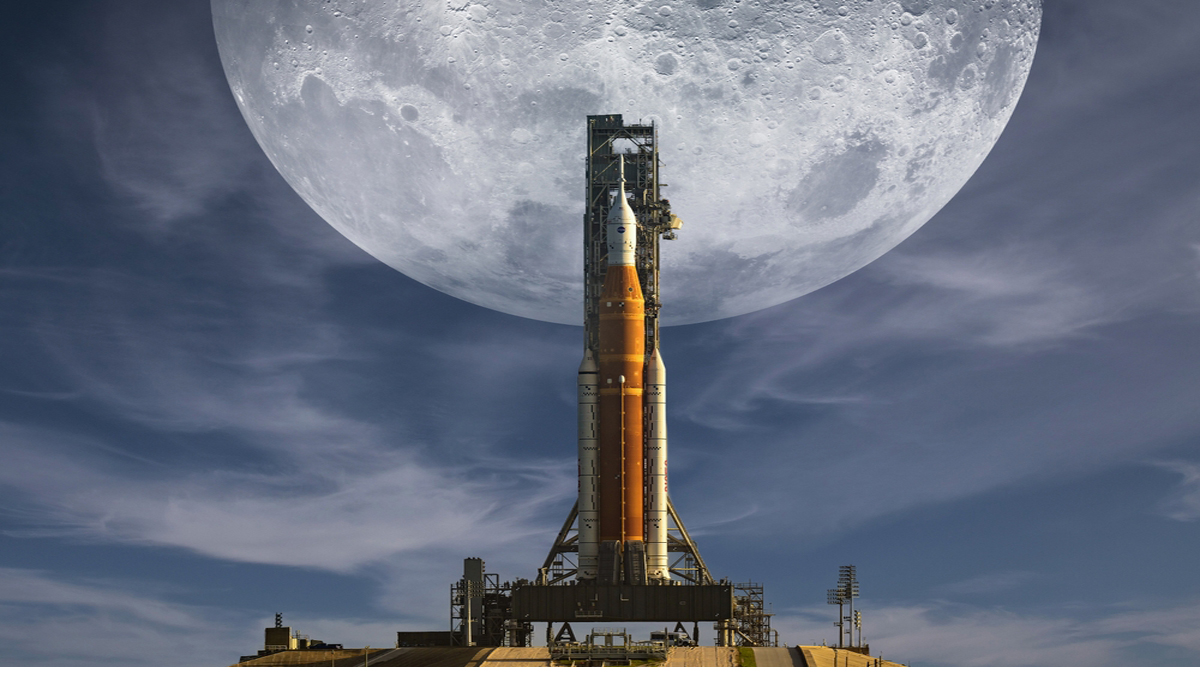
New Delhi, March 27, 2026 — For the first time in over five decades, the silhouette of a crewed lunar rocket stands ready on the launchpad at NASA’s Kennedy Space Center. As of late March 2026, the Space Launch System (SLS) rocket, topped with the Orion spacecraft, has completed its final rollout to Launch Complex 39B, signaling the dawn of a new era in deep-space exploration.
Targeted for liftoff as early as April 1, 2026, the Artemis II mission will carry four astronauts on a 10-day journey around the Moon. This mission serves as the critical “flight test” before NASA attempts to land humans on the lunar surface later this decade.
The Mission: A High-Stakes Lunar Flyby
Unlike the uncrewed Artemis I mission in 2022, Artemis II is a crewed “Hybrid Free-Return Trajectory.” The mission is designed to push the limits of the Orion spacecraft’s life-support systems while keeping the crew on a path that uses the Moon’s gravity to naturally pull them back to Earth.
- Duration: Approximately 10 days.
- Distance: The crew will travel roughly 6,400 miles (10,300 km) beyond the far side of the Moon.
- The Goal: To verify that all human-centric systems—including air scrubbing, water recycling, and exercise equipment—can sustain astronauts in the harsh environment of deep space.
Meet the Historic Crew
The Artemis II crew is a tapestry of “firsts,” representing a more inclusive approach to the “Artemis Generation” of explorers:
| Astronaut | Role | Historic Note |
| Reid Wiseman | Commander | Decorated U.S. Navy Captain and former ISS resident. |
| Victor Glover | Pilot | The first person of color to participate in a lunar mission. |
| Christina Koch | Mission Specialist | The first woman to fly to the vicinity of the Moon. |
| Jeremy Hansen | Mission Specialist | The first non-American (Canadian Space Agency) to leave Earth’s orbit. |
The crew entered official health stabilization (quarantine) on March 18, 2026, to ensure they remain healthy before their historic departure.
Engineering the Giant: The SLS Block 1
Standing at 322 feet tall, the Space Launch System remains the most powerful rocket ever successfully flown. For the Artemis II launch, engineers have integrated several upgrades following the 2022 test flight:
- Helium Flow Optimization: Following a minor valve issue in February, the upper stage (ICPS) has been cleared for flight.
- Laser Communications: Artemis II will debut the O2O (Orion Optical Communications) system, using infrared lasers to beam 4K video and data back to Earth at 260 Mbps—far faster than the radio waves used during the Apollo era.
- Radiation Shielding: Orion is equipped with advanced sensors and a “storm shelter” to protect the crew from solar particle events as they travel beyond Earth’s magnetic field.
Looking Toward the Horizon
The success of Artemis II is the gatekeeper for the rest of the program. While Artemis III—originally the landing mission—has been shifted to mid-2027 to serve as an Earth-orbit docking demonstration, NASA’s eyes remain fixed on the lunar south pole.
The agency recently confirmed that Artemis IV, scheduled for 2028, is now slated to be the first mission to return humans to the lunar surface since Apollo 17 in 1972.