Home Blog Page 226

Indian Navy SSC Officer Recruitment 2026: Registration Window Closes Today for 260 Posts

0

New Delhi | February 24, 2026: The Indian Navy is set to close the online application window for the Short Service Commission (SSC) Officer recruitment for the January 2027 course today, February 24, 2026. Eligible unmarried men and women who aspire to serve in the prestigious naval forces must complete their registration by the end of the day to avoid last-minute technical glitches.

This recruitment drive aims to fill a total of 260 vacancies across various branches, including Executive, Education, and Technical wings. Interested candidates can apply directly through the official recruitment portal.

Vacancy Breakup: Branch-wise Details

The 260 available positions are distributed across several specialized cadres. The Executive branch holds the largest share of vacancies this cycle.

BranchCadre/EntryVacancies
ExecutiveGeneral Service (GS/X) / Hydro76
Pilot25
Naval Air Operations Officer (NAOO)20
Air Traffic Controller (ATC)18
Logistics10
TechnicalEngineering Branch (General Service)42
Electrical Branch (General Service)38
Submarine Technical (Engineering/Electrical)16
EducationEducation Officer15

Eligibility Criteria at a Glance

To maintain the high standards of the Indian Navy, candidates must meet specific academic and age requirements:

  • Educational Qualification: Most entries require a BE/B.Tech degree in any discipline or specific engineering streams with a minimum of 60% marks. For the Education branch, candidates with M.Sc, M.A, or M.Tech in relevant subjects are eligible.
  • Special Requirements: For Pilot, ATC, and NAOO entries, candidates must have secured at least 60% aggregate marks in Class 10 and 12, with a minimum of 60% in English.
  • Age Limit: While it varies slightly by branch, the general age bracket for applicants is those born between January 2, 2002, and July 1, 2007 (both dates inclusive).

Selection Process

The Indian Navy follows a rigorous multi-stage selection process:

  1. Shortlisting: Applications are shortlisted based on the normalized marks obtained in the qualifying degree.
  2. SSB Interview: Shortlisted candidates will be called for the Services Selection Board (SSB) interview process.
  3. Medical Examination: Candidates who clear the SSB will undergo a comprehensive medical fitness test as per naval standards.
  4. Merit List: Final selection is based on SSB marks and medical fitness, subject to the number of vacancies.

How to Apply: Step-by-Step Guide

Candidates have until 11:59 PM tonight to submit their forms. There is no application fee for this recruitment.

  • Step 1: Visit the official website [suspicious link removed].
  • Step 2: Click on the “Register” tab if you are a new user, or “Login” if already registered.
  • Step 3: Fill in the personal, educational, and communication details accurately.
  • Step 4: Upload scanned copies of the required documents (Degree certificates, Marksheets, Passport photo, and Signature).
  • Step 5: Review the application carefully and click “Submit.”
  • Step 6: Download and print a copy of the application for future reference.

Note: Ensure all uploaded documents are legible. The Indian Navy warns that multiple applications from the same candidate may lead to disqualification.
Veteran Actor Dalip Tahil Survives Rafting Mishap in Rishikesh

0

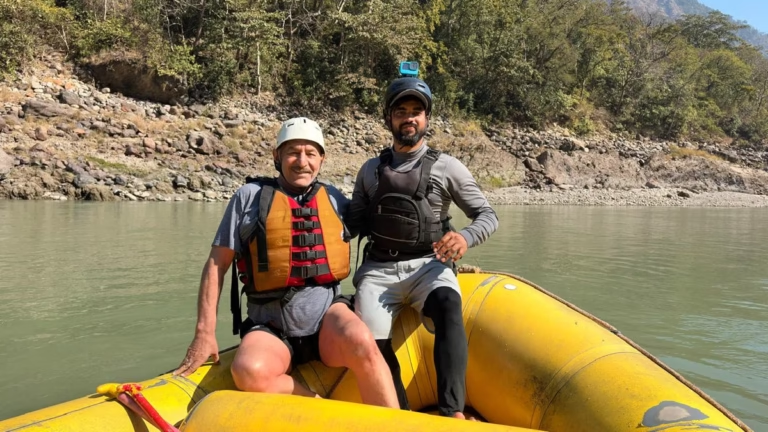
New Delhi, February 24, 2026: The scenic rapids of the Ganges in Rishikesh became the backdrop for a dramatic real-life scene this week when veteran Bollywood actor Dalip Tahil experienced a harrowing capsizing incident. The 73-year-old actor, known for his iconic roles in films like Baazigar and Qayamat Se Qayamat Tak, was enjoying a white-water rafting session when his raft hit a turbulent stretch and flipped, tossing him into the icy waters.

The Incident: A Close Call on the Rapids

Tahil was reportedly navigating a challenging section of the river with a group of friends and professional guides. Despite the safety precautions in place, the unpredictable force of the Ganga proved too much for the raft, leading to an immediate overturn.

Eyewitnesses noted that the actor remained remarkably calm despite the shock of being submerged. Safety kayakers and guides on the scene acted swiftly, pulling the actor from the water and ensuring he reached the riverbank safely. Fortunately, Tahil escaped the incident without any major injuries, though the physical toll of the cold water and the impact was evident.

“Puraane Paapi”: A Moment of Wit Amidst the Chaos

In true veteran fashion, Tahil didn’t let the scare dampen his spirits. Following the rescue, a video surfaced showing the actor reflecting on the experience with his trademark dry wit.

Referencing the river’s spiritual significance—and perhaps his own long career playing sophisticated villains—Tahil joked:

“Ganga ne is puraane paapi ko pehchaan liya” (The Ganges recognized this old sinner).

The comment, a playful nod to the Hindu belief that a dip in the holy river washes away one’s sins, quickly went viral. Fans have praised the actor for his resilience and his ability to find humor in a potentially life-threatening situation.

Safety First: The Risks of Adventure Sports

While the incident ended on a lighthearted note, it serves as a reminder of the inherent risks involved in adventure sports, particularly for seniors. Authorities in Rishikesh continue to emphasize:

  • Mandatory Life Jackets: Even for strong swimmers, the current is unforgiving.
  • Professional Guides: Always raft with certified operators who have rescue protocols.
  • Health Checks: High-adrenaline sports can place significant strain on the heart and respiratory system.

A Legacy of Resilience

Dalip Tahil has been a staple of Indian cinema and theater for over four decades. From playing the stern father to the calculating antagonist, his versatility is well-known. This recent “adventure” in Rishikesh only adds to the legend of an actor who remains active, adventurous, and full of life even in his 70s.

Fans and colleagues from the film industry have taken to social media to express their relief at his safety, with many echoing that his “villainous” charm on screen is clearly matched by a tough-as-nails spirit in real life.

UPSC CSE 2026: Application Deadline and Major Reforms

0

New Delhi, February 24, 2026 — The Union Public Service Commission (UPSC) is set to close the registration window for the Civil Services Examination (CSE) 2026 at 6:00 PM today. With 933 vacancies up for grabs across prestigious services like the IAS, IPS, and IFS, the 2026 cycle stands out not just for the competition, but for a suite of “high-tech” reforms and stricter service rules designed to modernize the recruitment process.

Aspirants who have not yet completed their forms are advised to log on to the official portals, upsc.gov.in or upsconline.nic.in, immediately to avoid last-minute server congestion.

Key Highlights of UPSC CSE 2026

The 2026 notification has introduced several shifts in how candidates apply and how their eligibility is maintained throughout the exam cycle.

FeatureDetails
Total Vacancies933 (Includes 33 for PwBD)
Last Date to ApplyFebruary 24, 2026 (by 18:00 hrs)
Correction Window3 days (opening after Feb 24)
Prelims Exam DateMay 24, 2026 (Sunday)
Mains Exam DateAugust 21, 2026 (Friday onwards)

Major Reforms Introduced in 2026

The UPSC has implemented significant technological and administrative changes this year to ensure transparency and prevent “seat blocking.”

1. Enhanced Security: Live Photo & Face Authentication

In a major tech-overhaul, the application process now requires a Mandatory Live Photo Capture. Gone are the days of uploading old studio photos; candidates must now use a webcam or mobile camera to capture their likeness in real-time. Furthermore, the Commission has introduced Face Authentication at exam venues to curb impersonation.

2. The Four-Stage Application System

The online portal has been restructured into four distinct modules:

  • Universal Registration Number (URN): A permanent ID for all future UPSC exams.
  • Common Application Form (CAF): General details.
  • Triple Signature Upload: Candidates must now upload three signatures for cross-verification.
  • Exam-Specific Module: Where candidates select their center and pay the fee.

3. Stricter Rules for Serving Officers

To prevent candidates from repeatedly holding multiple top-tier seats, the 2026 rules are more rigid:

  • IAS & IFS Restriction: Candidates already appointed to the Indian Administrative Service (IAS) or Indian Foreign Service (IFS) are not eligible to appear for CSE 2026.
  • The “One-Time Improvement” Rule: IPS or Group ‘A’ officers are allowed one improvement attempt (CSE 2027) only if they take a formal training exemption. Beyond this, they must resign to appear again in 2028 or later.

Eligibility and Application Fee

The basic eligibility remains a graduate degree from a recognized university. The age limit is calculated as of August 1, 2026, with the general bracket being 21 to 32 years (relaxable for OBC, SC, ST, and PwBD categories).

Note on Fees: A nominal fee of ₹100 is applicable for General/OBC/EWS male candidates. Female candidates and those from SC/ST/PwBD categories are exempted from the fee.

What Happens After Today?

Once the application window closes at 6:00 PM, the Commission will provide a 3-day correction window for candidates to rectify errors in their forms. However, certain fields like the URN profile may have limited editing options.

The Preliminary Examination, consisting of GS Paper I and the qualifying CSAT Paper II, will take place on May 24, 2026. Candidates qualifying this stage will be eligible for the Main Examination starting August 21, 2026.

Kerala HC Questions ‘The Kerala Story 2’ Certification

0

New Delhi, February 24, 2026: The Kerala High Court on Tuesday raised serious concerns regarding the portrayal of the state in the upcoming film The Kerala Story 2: Goes Beyond. While hearing a batch of petitions seeking a stay on the film’s release, the court questioned the Central Board of Film Certification (CBFC) on how a “U/A” certificate was granted to a project that potentially misrepresents the social fabric of Kerala.

Justice Bechu Kurian Thomas, presiding over the matter, emphasized that Kerala is a state where people of all faiths coexist in “total harmony.” The court’s oral observations highlighted a growing judicial unease with the film’s title and its alleged potential to incite communal passions.

The Core of the Controversy

The sequel to the 2023 hit The Kerala Story has been at the center of a fresh legal and political storm since its trailer was unveiled earlier this month. The petitioners, including a resident from Kannur, argued that the film’s promotional material depicts incidents of forced religious conversion and extremist recruitment as if they are occurring “all over the state.”

The court noted that while the filmmakers claim the story is “inspired by true events,” the inclusion of “Kerala” in the title—despite the narrative allegedly spanning multiple other states—could lead to the unfair stigmatization of the region.

“Kerala lives in total harmony. But you have portrayed that this is happening all over Kerala. There is a wrong indication and it can also incite passion,” Justice Thomas remarked during the proceedings. The judge further noted that the apprehensions of the people of Kerala “cannot be ignored” when the state’s name is being used so prominently in the title.

Legal Challenges and CBFC Scrutiny

The petitions challenge the CBFC’s decision to grant a U/A 16+ rating to the film. Under Section 5B of the Cinematograph Act, 1952, the Censor Board is mandated to ensure that films do not threaten public order, decency, or incite the commission of any offense. The petitioners contend that the board failed to apply these statutory safeguards, particularly concerning the film’s teaser, which ends with the slogan: “Ab sahenge nahi, ladenge” (We will not tolerate it anymore, we will fight).

Lawyers for the petitioners argued that such a tagline could be interpreted as a call for retaliatory action, posing a “real and imminent” threat to law and order.

In a significant turn during the hearing, the court was informed that the film’s teaser had not actually been cleared by the CBFC. Following this revelation, the producers agreed to remove the teaser from all digital platforms.

Comparison with the 2023 Original

The first installment of The Kerala Story faced similar hurdles in 2023. At that time, the Supreme Court of India had directed the filmmakers to include a disclaimer stating that the film was a fictionalized account and that there was no authentic data to support its original claim that 32,000 women had joined ISIS.

The High Court observed on Tuesday that the “presumption of validity” that comes with a CBFC certificate is not absolute and can be rebutted if the content of the film is found to incite communal disharmony.

What’s Next?

To make an informed decision on whether to stay the release, the Kerala High Court has asked the Union Government and the filmmakers to arrange a private screening for the bench. The court intends to examine the film’s content directly to determine if the “microscopic” disclaimers are sufficient to balance artistic freedom with social responsibility.

The Kerala Story 2: Goes Beyond, directed by Kamakhya Narayan Singh and produced by Vipul Amrutlal Shah, is currently scheduled for a nationwide theatrical release on February 27. The High Court is expected to pass further orders following the special screening.

Miracle at Sea: All 7 Rescued in Andaman Helicopter Crash

0

New Delhi, February 24, 2026: In a dramatic turn of events on Tuesday morning, all seven people on board a Pawan Hans helicopter were miraculously rescued after the aircraft ditched into the sea near Mayabunder. The incident, which occurred around 9:30 AM, triggered a swift emergency response from local authorities and the Indian Coast Guard, preventing what could have been a major tragedy.

The Incident: A Race Against Time

The helicopter, operated by the state-owned Pawan Hans Ltd, was performing a routine inter-island service. It departed from Sri Vijaya Puram (formerly Port Blair) at approximately 8:45 AM, heading toward the northern districts.

According to officials, the aircraft was on its final approach to the Mayabunder airstrip when it encountered a suspected technical snag. Forced to make a split-second decision, the pilot executed a controlled “ditching” (emergency water landing) roughly 300 meters short of the runway.

Survivors and Rescue Efforts

The aircraft was carrying five passengers and two crew members at the time of the crash. The passengers have been identified as:

  • Rajita Devi and her infant, Kamal Ch. Das
  • Sipra Saha
  • Nambi Amma
  • (Additional male passenger)

Following the impact, rescue teams including the Indian Coast Guard and local emergency services reached the site within minutes. All seven occupants were successfully pulled from the water and transported to Dr. Rajendra Prasad Hospital in Mayabunder for observation.

“All seven people on board, including the pilot, are safe. We are currently ensuring they receive necessary medical care, and efforts are underway to move them back to Sri Vijaya Puram for further assessment,” stated Nitesh Rawat, Director of Civil Aviation.

Safety Scrutiny and Investigation

The incident has raised immediate concerns regarding aviation safety in the region, particularly as it follows a fatal air ambulance crash in Jharkhand just 24 hours prior.

The Directorate General of Civil Aviation (DGCA) has initiated a formal inquiry into the crash. While the pilot’s skillful maneuver in landing on water is being credited for saving lives, investigators will focus on the maintenance history of the aircraft and the specific nature of the technical failure.

Key Facts of the Incident:

  • Time of Crash: 09:30 AM (approx.)
  • Location: 300 meters from Mayabunder runway.
  • Carrier: Pawan Hans (inter-island service).
  • Casualties: None; all seven rescued.

Connecting the Islands

Pawan Hans serves as a lifeline for the Andaman and Nicobar archipelago, providing essential connectivity to remote islands where fixed-wing aircraft cannot operate. While this incident ended safely, it underscores the challenges of operating in maritime environments and the critical importance of rigorous maintenance protocols for island transport.

Faith Over Family: Son Rejects Long-Lost Mother

0

New Delhi, February 24, 2026: In a poignant incident that has sparked intense debate over the intersections of faith, family, and time, a 55-year-old woman’s return to her ancestral home after 25 years ended in heartbreak. The reunion, decades in the making, was cut short not by a lack of memory, but by a shift in religious identity.

The woman, identified as Sunita (name changed), arrived in her village on the outskirts of Varanasi this week, hoping to reconnect with the son she had not seen since he was a young child. However, the emotional homecoming turned cold when her son, now a 29-year-old devout Hindu, refused to let her cross the threshold upon learning of her conversion to Christianity.

A Quarter-Century of Silence

The details of Sunita’s departure 25 years ago remain blurred by time and conflicting family narratives. According to local sources, Sunita left the household following a series of personal hardships and domestic disputes. She eventually moved to a different state, where she found solace and support within a Christian community, eventually adopting the faith as her own.

For over two decades, there was little to no contact between Sunita and her biological family. Her son, Rajesh (name changed), was raised by his paternal grandparents in a strictly traditional environment.

The Encounter: “Sorry Mom, You Are a Christian”

Witnesses state that the confrontation took place in the courtyard of the family home. Neighbors who gathered to see the “long-lost mother” described a scene that shifted rapidly from curiosity to tension.

When Sunita revealed her new identity and her life as a practicing Christian, Rajesh’s demeanor reportedly shifted. According to local reports, his refusal was blunt:

“I have spent my life performing rituals for a mother I thought was dead or gone. Now you return, but you are not the mother I remember. Our faiths cannot coexist under this roof. Sorry mom, you are a Christian now.”

Despite Sunita’s pleas that her love for her son remained unchanged by her theology, the door remained closed.

The Societal Divide

The incident has highlighted the growing chasm in communal and familial dynamics regarding religious conversion in rural India. While some villagers expressed sympathy for the mother, citing that “a mother’s bond should transcend religion,” others stood by the son, arguing that his devotion to his ancestral traditions and the “Dharma” of the household justified his stance.

Key Points of Contention:

  • The Length of Absence: Many argue that 25 years is too long a gap to bridge, regardless of religion.
  • Identity vs. Lineage: The conflict between a person’s right to choose their faith and a family’s desire to maintain traditional lineage.
  • The Emotional Toll: The psychological impact on both the mother, seeking redemption, and the son, who felt abandoned.

Current Status

Sunita is reportedly staying with a local acquaintance while she decides her next course of action. Local community leaders have attempted to mediate the situation, but Rajesh remains steadfast in his decision, citing his commitment to his religious practices and the “sanctity” of his home.

As of now, no legal complaints have been filed, as the matter is being treated as a private family dispute. However, the story continues to resonate across social media, prompting a wider conversation about whether blood is indeed thicker than the waters of baptism or the fires of tradition.

The “Water Gun” Pani Puri: Mumbai Vendor’s Viral “Combat Style” Snack

0

New Delhi, February 24, 2026: Mumbai’s legendary street food scene has just leveled up—literally. In a city where pani puri is a religion, one local vendor has traded the traditional copper pot and ladle for a high-pressure water gun, serving what locals are calling “Combat Style” Pani Puri.

The viral sensation has taken social media by storm, proving that in the competitive world of Indian street snacks, a little bit of theater goes a long way.

A High-Pressure Twist on a Classic

Traditionally, the “Puri” (a hollow, crispy semolina ball) is filled with a mixture of mashed potatoes and chickpeas before being dipped into a vessel of spicy, tangy water (jaljeera).

At this particular stall, the “Pani Puri Wala” has modernized the process. Using a modified, pressurized water dispenser shaped like a tactical water gun, the vendor “aims and fires” the spicy jaljeera directly into the puri held by the customer.

What makes it “Combat Style”?

  • Precision Aim: The vendor fills the puri with a quick, tactical burst of water.
  • The Speed: The high-pressure stream allows for rapid-fire service, keeping up with Mumbai’s frantic pace.
  • The Experience: Customers describe it as a mix of a snack break and a carnival game.

The Rise of “Food-tainment”

This isn’t just about the taste; it’s about the spectacle. Mumbai has seen various iterations of the snack—from “Flying Vada Pav” to “Cheese-Burst Dosa”—but the water gun pani puri taps into a growing trend of “food-tainment.”

“It’s hygienic and incredibly fun,” says one customer in a viral video. “Usually, you worry about hands dipping into the water. Here, it’s a direct shot from the gun to the plate. It feels like Holi in the middle of a workday!”

Hygiene Meets Innovation

Beyond the gimmick, the “Combat Style” method addresses a long-standing concern for street food enthusiasts: hygiene.

  1. Zero Contact: The vendor’s hands never touch the water.
  2. Controlled Portions: The pressurized system ensures a consistent mix of spices in every shot.
  3. Freshness: The jaljeera is kept in a sealed container rather than an open pot, preserving the zingy flavors of mint, tamarind, and cumin.

Where to Find It

While several vendors across the suburbs of Mumbai are beginning to adopt similar “tactical” gear, the trend is most prominent in the bustling food hubs of Juhu and Kandivali.

As the videos continue to rack up millions of views, it’s clear that Mumbai’s street food culture remains as resilient and inventive as ever. Whether you’re a spice-seeker or just looking for a good laugh, this is one “battle” you’ll want to be on the front lines for.

Samsung Galaxy Book6 Series: US Launch Set for March 11

0

New Delhi, February 24, 2026: Samsung has officially confirmed that its next-generation flagship laptop lineup, the Galaxy Book6 Series, will hit the United States market on March 11, 2026. Following a high-profile debut at CES 2026, the new series is being hailed as Samsung’s most advanced PC offering to date, blending high-performance silicon with deep AI integration.

The 2026 lineup features three core models: the Galaxy Book6 Ultra, the Galaxy Book6 Pro, and the standard Galaxy Book6, all designed to cater to a spectrum of users from creative professionals to everyday students.

Cutting-Edge Silicon: The Intel 18A Breakthrough

The defining feature of the Galaxy Book6 series is its heart: the Intel Core Ultra Series 3 (Panther Lake) processors. These are the first consumer chips manufactured on the Intel 18A (1.8nm-class) process.

According to Samsung, this architectural leap provides a 60% boost in CPU performance over the previous generation. This efficiency doesn’t just mean speed; it translates to incredible endurance. The Pro and Ultra models are rated for up to 30 hours of video playback on a single charge—a new benchmark for the Windows ecosystem.

  • Ultra Performance: The Galaxy Book6 Ultra is a workstation in a laptop frame, offering configurations with NVIDIA GeForce RTX 5060 or 5070 Laptop GPUs.
  • Thermal Redesign: To manage this power, Samsung implemented a wider vapor chamber and a thinner, more efficient fan system. The 16-inch Pro model now includes a vapor chamber for the first time, ensuring sustained performance during heavy workloads.

The Era of On-Device Galaxy AI

Samsung is positioning the Galaxy Book6 as the ultimate “AI PC.” With an integrated NPU capable of up to 50 TOPS, the series handles complex AI tasks locally rather than relying on the cloud.

Key software innovations include:

  • AI Select & Search: Users can highlight content and use natural language to find information or perform actions.
  • Seamless Ecosystem: Features like Multi Control and Second Screen allow users to drag-and-drop files between their phone, tablet, and laptop as if they were a single device.
  • Enhanced Visuals: AI-driven image cleanup and live translation are now smoother and faster than ever.

Display and Industrial Design

Samsung continues to lead in screen technology with its Dynamic AMOLED 2X touch displays, available on the Pro and Ultra models.

  • Visibility: The screens offer up to 1,000 nits of peak HDR brightness and a variable refresh rate of 30Hz to 120Hz.
  • Refined Protection: Protected by Corning Gorilla Glass with DXC, reflections are reduced by up to 75%, making the laptops usable even in direct sunlight.
  • The Slim Factor: The 16-inch Galaxy Book6 Pro is strikingly thin at just 11.9mm, while the powerful Ultra measures only 15.4mm.

U.S. Pricing and Availability

The Galaxy Book6 Series will be available starting March 11, 2026, via Samsung.com, Samsung Experience Stores, and major retailers like Best Buy.

ModelStarting Price (USD)Best For
Galaxy Book6$1,049.99Portability and everyday tasks
Galaxy Book6 Pro$1,599.99Professionals needing OLED & power
Galaxy Book6 Ultra$2,449.99Creators, gamers, and heavy multitaskers

Samsung is also offering a $30 reservation credit for those who sign up early on their website, along with competitive trade-in offers. For business users, the Galaxy Book6 Enterprise Edition is slated for a late spring 2026 release.

Mystery in Odisha: How a Newly-Wed’s ‘Kidnapping’ Was Exposed as a Hoax

0

New Delhi, February 24, 2026: In a case that gripped the local community and sent the Odisha police on a high-stakes chase, the mysterious disappearance of a newly-married woman has taken a startling turn. What was initially reported as a daring broad-daylight abduction has been revealed as a meticulously planned staged kidnapping, orchestrated by the woman herself.

Here is the step-by-step breakdown of how the case unfolded, from the initial alarm to the eventual revelation.

The Incident: A Sudden Disappearance

The drama began just days after the wedding ceremony. According to the initial police report filed by the family, the young woman had gone missing under suspicious circumstances.

The family claimed that she had stepped out for a routine errand or was traveling when she was intercepted by “unidentified men.” To add weight to the kidnapping narrative, the family soon began receiving distressing phone calls and ransom demands, leading to a state of panic and immediate police intervention.

The Police Investigation: Red Flags Emerge

Local authorities treated the case with high priority, forming special teams to track the “kidnappers.” However, as investigators began digging deeper, several inconsistencies started to surface:

  • CCTV Footage: Surveillance cameras near the alleged site of the abduction showed the woman moving voluntarily, without any signs of struggle or coercion.
  • The Ransom Calls: Technical analysis of the phone calls revealed that the signals were originating from locations that didn’t align with a typical “hideout.”
  • The Timeline: Witnesses reported seeing the woman in areas where she was supposedly being held captive, but she appeared to be acting of her own volition.

The Turning Point: Tracing the Digital Footprint

The breakthrough came through cyber-forensics. By tracking the mobile IMEI numbers and social media activity, the police located the woman in a neighboring district.

When the police team moved in to “rescue” her, they found her not in a hostage situation, but residing comfortably. Under questioning, the facade quickly crumbled.

The Confession: Why She Did It

The woman eventually confessed to plotting the entire scheme. The investigation revealed that she was unhappy with the marriage, which she claimed had been arranged against her wishes. Unable to find a way out through traditional means, she decided to stage her own kidnapping to:

  1. Escape her in-laws’ house without an immediate confrontation.
  2. Join a partner or start a new life elsewhere under a different identity.
  3. Buy time by creating a distraction that would keep her family occupied with “searching” for her.

Legal and Social Implications

The Odisha police have expressed their frustration over the waste of public resources. While the woman has been located, she now faces potential legal action for misleading public servants and filing a false report.

Key Takeaways from the Case

This case serves as a stark reminder of the complexities of matrimonial disputes and the lengths to which individuals may go when they feel trapped in social contracts. It also highlights the efficiency of modern digital tracking in debunking elaborate hoaxes.

Lakshay Jaggi Clarifies Viral “Snub” of Rakul Preet Singh

0

New Delhi, February 24, 2026: A fleeting moment at a recent awards ceremony has escalated into a major social media controversy. Fitness influencer Lakshay Jaggi has finally addressed the viral clip that showed him seemingly “snubbing” Bollywood actress Rakul Preet Singh on stage.

The video, which has been circulating across Instagram and X (formerly Twitter), sparked a divide among netizens, with many calling out the influencer for being “disrespectful” to the actress.

The Viral Incident: What Happened on Stage?

In the widely shared footage from the event, Rakul Preet Singh is seen presenting an award to Lakshay Jaggi. As Jaggi approaches, he accepts the trophy, but the interaction is notably brief. He exits the stage almost immediately without a handshake, a smile, or even making eye contact with the actress.

Netizens were quick to react, with comments ranging from calling his behavior “arrogant” to questioning why the influencer chose to ignore one of the industry’s most popular stars.

“Regardless of who you are, basic courtesy is a must on stage,” wrote one user, while another commented, “It looked like a deliberate avoid.”

Lakshay Jaggi Breaks His Silence: “No Tradition of Shaking Hands”

Following the backlash, Lakshay Jaggi took to his social media to provide his side of the story. According to the influencer, the clip lacks the context of what happened just seconds before he stepped onto the stage.

The Reasoning Behind the Snub

Jaggi explained that he was simply following the “vibe” or protocol he witnessed from the previous awardee.

  • The Preceding Moment: Jaggi claimed that an elderly woman (referred to by him as an “aunty-type lady”) received an award just before him.
  • The Missed Handshake: He alleged that when this woman extended her hand for a handshake, Rakul Preet Singh did not reciprocate.
  • The Decision: Observing this, Jaggi concluded that there might be a “no-handshake” policy or custom in place for the evening.

In his video response, Jaggi stated in Hindi:

“I didn’t go there to insult anyone. I saw that a lady before me tried to shake hands and it didn’t happen. So I thought, ‘Haath milane ka koi rivaaz nahi hai’ (There is no custom of shaking hands here). I just took the award and moved ahead. How was I to know it would be seen as an insult?”

Who is Lakshay Jaggi?

For those unfamiliar with the name, Lakshay Jaggi is a prominent fitness influencer with a following of over 400,000 on Instagram. He is well-known in the digital space for his transformation journeys, gym tips, and lifestyle content.

Rakul Preet Singh’s Upcoming Projects

While the actress has not officially commented on the “snub,” she remains busy with her upcoming professional commitments. Fans are eagerly waiting to see her in ‘Pati Patni Aur Woh 2’, alongside Ayushmann Khurrana and Sara Ali Khan. Originally slated for a Holi release, the film is now expected to hit theaters on May 15, 2026.