Home Blog Page 28

The Promise of Home: Why Radhika Ambani Chose India Growth Over US Turmoil

New Delhi, June 11, 2026: In a candid reflection on her formative years, Radhika Ambani (née Merchant) has opened up about the pivotal moments that led her to leave the United States and return to India. Speaking at the headquarters of India’s International Movement to the United Nations (IIMUN), the younger daughter-in-law of billionaire industrialist Mukesh Ambani shared an inspiring perspective on national pride, economic momentum, and a concept she calls “emotional infrastructure.” Her remarks offer a unique window into the minds of young, overseas-educated Indians who are increasingly choosing to build their futures at home rather than chasing the traditional American Dream.

A Tale of Two Nations: Volatility vs. Opportunity

For Radhika, who studied Political Science at New York University (NYU), the choice to return to India was solidified by the stark contrast between the political landscapes of both countries at the time. When she was finishing her studies, Donald Trump was ascending to the U.S. presidency for his first term.

While the United States was navigating a period of deep political polarization and societal friction, India was moving in a radically different direction. Back home, the Bharatiya Janata Party (BJP) had secured a strong government mandate, signaling a period of prolonged political stability. For a political science student, the juxtaposition was impossible to ignore. One nation felt fractured and unpredictable, while the other seemed to be gathering its strength for a massive developmental leap.

The Madison Square Park Turning Point

While living in New York, one specific event completely reshaped Radhika’s outlook on India’s future. She attended Prime Minister Narendra Modi’s massive community rally at Madison Square Garden. Witnessing the immense energy, the optimism of the diaspora, and the forward-looking vision articulated on that global stage changed everything for her.

The rally highlighted a booming macroeconomic reality. Radhika noted that India’s economy was accelerating at an impressive growth rate of around 8.5%, while the United States was growing at a much more modest 2% to 3%. For a young graduate looking to make a meaningful impact, the math was simple: India was where the action was. It was no longer a developing nation to be left behind, but an economic engine full of untapped possibilities.

Digital Evolution and Infrastructure

Beyond pure GDP numbers, Radhika was deeply impressed by the rapid modernization of India’s public infrastructure. The country was undergoing a digital revolution that was entirely redefining daily life and commerce. The rollout of foundational systems transformed India into one of the most technologically progressive environments in the world.

  • Aadhaar & UPI: The world’s largest biometric ID system combined with the Unified Payments Interface (UPI) modernized digital banking, making instant transactions accessible to hundreds of millions.
  • The Jio Effect: The launch of Reliance Jio democratized data, bringing affordable internet access to every corner of the country and sparking a massive tech boom.

Seeing these structural changes from afar made her realize that India was equipping its citizens with tools that rivaled, and in some cases surpassed, Western digital frameworks. The momentum felt tangible, and the country was visibly evolving into a global powerhouse.

Building on ‘Emotional Infrastructure’

Perhaps the most resonant part of Radhika’s reflection was her introduction of the concept of “emotional infrastructure.” While structural assets like highways, high-speed rail, and modern airports are critical for an economy, she argued that they are secondary to the human networks that sustain us.

For Radhika, returning home meant plugging back into a foundational network of family, culture, and community support. She emphasized that true personal and professional fulfillment comes from creating value in a place where you have deep roots, surrounded by the people who invested in your growth.

A Moral Responsibility to the Nation

Today, Radhika serves as the Executive Director on the board of Encore Healthcare, her family’s pharmaceutical firm, and has fully integrated into her role within the Ambani family. Ultimately, her choice to return wasn’t just driven by financial prospects or corporate career paths; it was a decision rooted in personal values.

She concluded her address by sharing a deep-seated sentiment shared by an entire generation of returning expats: a profound sense of duty. “As a person, it depends on your moral standing. Like I had a huge feeling of responsibility to build for the country,” she stated.

Her journey stands as a powerful testament to India’s shifting global perception. For decades, the narrative was dominated by “brain drain,” where India’s brightest talent permanently migrated westward. Now, stories like Radhika’s showcase a growing trend of “brain gain”—where young leaders return home, driven by powerful economic opportunities, robust digital ecosystems, and an undeniable desire to shape the future of their own nation.

TRAGEDY ON THE GODAVARI: OVERCROWDED PILGRIM BOAT CAPSIZES IN MAHARASHTRA BEED DISTRICT

0

New Delhi, June 11, 2026: A spiritual journey turned into a scene of horror and chaos on Wednesday morning when an overcrowded boat carrying dozens of pilgrims capsized in the Godavari River. The tragic incident occurred near the prominent Purushottampuri temple area in the Majalgaon tehsil (administrative block) of Maharashtra’s Beed district.

Initial official reports confirmed that at least two women drowned in the mishap, while several other devotees sustained serious injuries. Dozens of passengers, including men, women, and children, were flung into the deep waters but were successfully pulled to safety by the swift and heroic actions of local villagers and rescue teams.

The Incident: A Sudden Disaster Midstream

The accident took place between 10:00 AM and 11:00 AM on Wednesday, June 10. The Godavari River was bustling with religious activity due to the auspicious ongoing holy month of Adhik Maas (also referred to as Purushottam Maas). The Purushottampuri temple, located roughly 20 to 25 kilometers from Majalgaon, is a highly revered destination as it houses the only shrine in India completely dedicated to Lord Purushottam. Thousands of devotees from across Maharashtra and neighboring regions had gathered at the riverbank to take a ritual holy dip before crossing the river to offer prayers at the temple.

Because the temple sits on the opposite bank, crossing by ferry is a standard and necessary routine for pilgrims. Witnesses reported that local boat operators, looking to maximize profits during the heavy morning rush, ignored basic safety guidelines.

According to preliminary administrative data, the ill-fated boat had an official safety license to carry a maximum of 20 passengers. However, operators reportedly crowded between 35 and 50 passengers onto the vessel. Eyewitness accounts described the boarding process as chaotic, with passengers packed tightly together.

As the heavily weighed-down boat reached the deeper, midstream currents of the Godavari River, the unequal distribution of weight caused it to lose balance. Within moments, the vessel listed sharply to one side and overturned completely, throwing everyone on board into the deep, fast-flowing river.

Heroic Rescues and Casualties

The sudden capsizing triggered instant panic. The air filled with desperate cries for help as victims struggled to stay afloat in the deep water. Fortunately, the accident occurred within sight of the riverbanks. Local youth, fishermen, and villagers standing nearby acted with incredible bravery and presence of mind. Without waiting for official emergency response teams, dozens of locals immediately dove into the river to pull people out.

Shortly after, local police personnel and district disaster management teams arrived at the site to formalize the rescue mission. The joint efforts managed to save the vast majority of the passengers. However, two lives could not be saved.

  • Pramila Sheshrao Rathod (54-55 years old), a resident of Lonar in the Buldhana/Washim district region. Hindustan Times
  • Kantabai Dyandev Andhale (53-60 years old), also traveling from the Washim district. Hindustan Times

Additionally, a 75-year-old devotee identified as Sindhubai Arjun Mavale was pulled from the river in an unconscious condition. Emergency responders rushed her to a private hospital in Majalgaon, where medical professionals reported her condition to be highly critical. The remaining injured survivors were admitted to nearby government and private healthcare facilities, where they are currently receiving treatment for shock, water inhalation, and minor physical trauma.

Public Anger Outbreak and Repeated Warnings

The tragedy has sparked massive public outrage against local administrative officials and commercial boat operators. Local residents and survivors allege that this disaster was entirely preventable and stems from a long-standing history of institutional neglect.

Shockingly, this is not an isolated event for the region. This capsize marks the third major water-safety incident along this specific stretch of the Godavari River within a single month:

  1. May 19: A local youth tragically drowned after venturing into the deep waters of the river. Hindustan Times
  2. Early June: Another boat carrying devotees overturned near the banks. Miraculously, there were no casualties in that incident because alert locals managed to pull everyone out in time. PTC News

Despite these clear, recurring warning signs, residents argue that the district administration failed to implement basic, common-sense safety protocols. Devotees point out that there was absolutely no enforcement regarding mandatory life jackets for commuters, nor were there any official checks to monitor and cap the maximum number of passengers entering the boats during high-traffic religious festivals.

Official Response and Higher-Level Inquiry

Following the disaster, Beed District Collector Vivek Johnson rushed to the accident spot to supervise the rescue operations, visit the survivors in the hospital, and comfort grieving family members. Acknowledging the clear lapse in safety and the severe overloading of the boat, the District Collector promised that strict punitive actions would be taken against anyone found guilty of negligence.

The local police have officially registered a criminal case against the boat operators and organizers under relevant sections of the law regarding endangerment of life and rash, negligent behavior.

Moving Forward: The Need for Strict Water Safety

As the holy Adhik Maas festival continues, thousands more pilgrims are expected to visit the Purushottampuri temple over the coming weeks. The district administration faces immense pressure to drastically overhaul crowd-management and river-crossing safety protocols immediately.

Safety experts emphasize that the administration must move away from reactive measures and deploy permanent enforcement officers at all active ferry points. Mandating high-quality life jackets for every passenger, establishing physical barricades to count and control boarding numbers, and strictly licensing only certified boat operators are crucial steps required to restore public confidence and protect human life.

For now, an aura of grief hangs over the sacred grounds of Purushottampuri, serving as a somber reminder of how commercial greed and administrative lapses can instantly turn a day of devotion into a day of mourning.

Rajasthan BSTC Pre D.El.Ed Result 2026 Declared

0

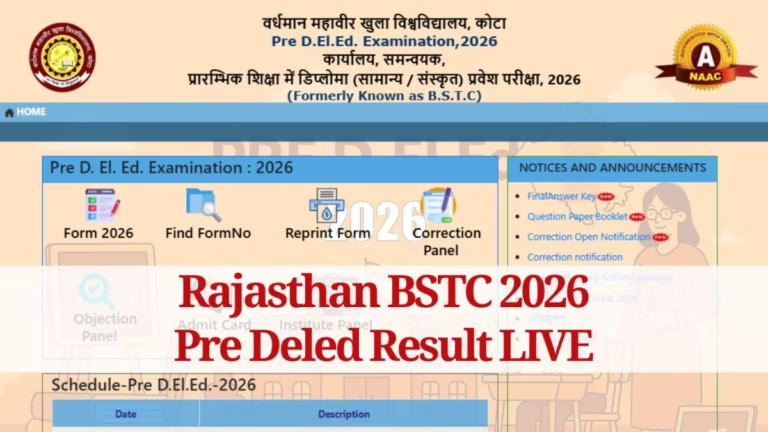
New Delhi, June 10, 2026: The Vardhman Mahaveer Open University (VMOU), Kota, has officially declared the results for the Rajasthan Basic School Teaching Course (BSTC) Pre Diploma in Elementary Education (Pre D.El.Ed) entrance examination. Candidates who have been anxiously waiting to check their performance can now access and download their scorecards directly from the official web portal at predeledraj2026.com.

The high-stakes state examination results were formally announced by the state’s Education Minister, Madan Dilawar, during a press briefing at the Jaipur Regional Centre of VMOU. The announcement event was presided over by the main coordinator and Vice-Chancellor of the university, Professor B.L. Verma. Although initially scheduled for release at precisely 3:00 PM, a brief technical delay kept candidates on the edge of their seats before the portal servers went fully live, allowing smooth navigation for test-takers to retrieve their credentials.

Direct Access: How to Check the Rajasthan Pre D.El.Ed Scorecard

To manage the heavy volume of traffic from nearly half a million candidates, the state education department has made the results available across verified online channels. Candidates need to use their unique login credentials to pull up their individual results.

The step-by-step procedure to access the digital scorecard is detailed below:

1.Visit the Official Portal:Step 1.

Open your web browser and navigate to the official designated results website: predeledraj2026.com or the fallback mirror at predeledraj2026.in.

2.Locate the Result Section:Step 2.

On the homepage, locate and click the prominent flashing link that reads “Rajasthan BSTC Pre D.El.Ed Result 2026”.

3.Enter Login Credentials:Step 3.

A secure sign-in portal will load. Carefully enter your assigned Application Number (or Roll Number) along with your Date of Birth (DD/MM/YYYY format).

4.Submit and Generate Scorecard:Step 4.

Double-check the entered credentials for accuracy and click on the “Submit” or “Sign In” button. Your detailed marksheet will populate on the screen.

5.Download and Print Document:Step 5.

Review the displayed details, then click the download icon to save a high-resolution PDF of your scorecard. It is highly recommended to take at least two physical printouts for the upcoming physical verification round.

Crucial Exam Statistics and Data Matrix

The Rajasthan BSTC exam remains one of the most competitive state-level entrance assessments for individuals looking to build a career in primary education. Passing this two-year foundational teacher training course is mandatory to qualify for the Rajasthan Third Grade Teacher Recruitment (Level-1, Primary School).

The table below breaks down the participation figures, seat matrices, and operational data recorded for this academic cycle.

Understanding the Cut-off Marks and Passing Criteria

To clear the entrance examination, candidates must satisfy minimum qualifying percentages explicitly mandated by the VMOU and the State Department of School Education. Scoring above the bare minimum passing threshold makes a candidate eligible to apply for counselling, though securing an actual seat depends entirely on the merit-based cut-offs which vary depending on institutional preferences and local seat density

Because there are nearly half a million examinees competing for just under 26,000 available seats, the actual competitive cut-off marks required to land a spot in a top-tier government institution are significantly higher than the baseline qualifying percentage. Academic experts tracking the exam trends estimate that General category candidates hoping for a secure placement in a Government District Institute of Education and Training (DIET) will likely need to target a merit score hovering between 420 to 460 marks. For reserved categories, the realistic competitive cut-off is projected to range anywhere from 380 to 410 marks, contingent heavily on the specific category and vertical reservation quotas.

What’s Next? The Pre D.El.Ed Counselling Roadmap

With the scorecards out, the entire focus shifts to the registration and distribution of seats via online counselling. The university has confirmed that the preliminary counselling preparations will initiate immediately, with formal online registrations slated to commence dynamically on June 11, 2026.

The chronological sequence of events for successful candidates is outlined below:

Online Registration & Choice Filling

Mid-June 2026

Eligible rank-holders must log onto the web portal to register for counselling. During this crucial window, candidates pay an initial registration fee and meticulously log their preferences of D.El.Ed colleges across the state.

First Round Seat Allotment

Late June / Early July 2026

The VMOU algorithms will process choices based strictly on state ranks, category reservation matrices, and college vacancies, ultimately generating the first allocation list.

Fee Payment & Physical Reporting

July 2026

Allotted candidates must deposit their institutional balance fee online and physically present themselves at their designated colleges with all original identity cards, scorecards, and academic certificates.

Upward Movement & Subsequent Rounds

Late July 2026

Unallocated candidates or those seeking a better college option can apply for the ‘Upward Movement’ phase, opening the doors to second and third allotment lists until all 25,970 spots are entirely occupied.

Troubleshooting Common Errors on the Result Page

Given the sheer volume of users simultaneously trying to hit the official website, candidates might experience temporary server timeouts, blank pages, or slow loading speeds. If you encounter an error page, avoid repeatedly smashing the refresh button as this compounds server strain. Instead, close the tab, clear your browser’s local cache data, and attempt to log in using an alternate browser or an incognito window.

Additionally, check your downloaded scorecard immediately for any typos regarding your name, category, or date of birth. If you detect any discrepancies between your actual credentials and what is printed on the generated PDF sheet, flag it immediately to the VMOU Kota helpline or the dedicated helpdesk email listed on the portal. Rectifying these profile anomalies now is critical, as any mismatches caught during physical reporting could lead to a sudden disqualification of your admission claim.

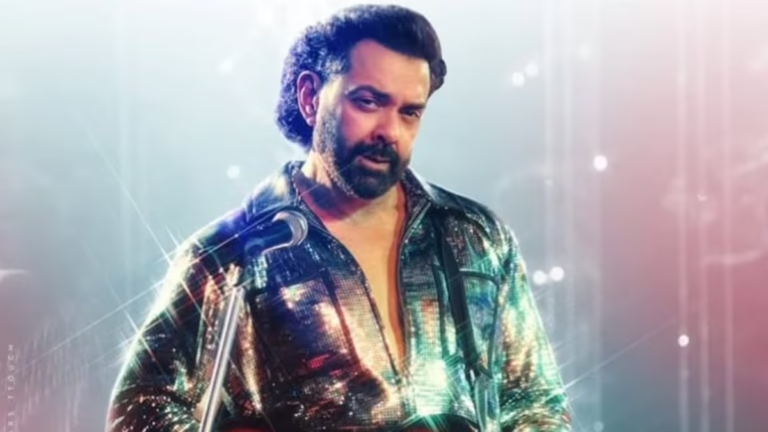
Bobby Deol’s Bandar Struggles on Day 5: Nets ₹3.15 Cr

New Delhi, June 10, 2026: Anurag Kashyap’s dark, gritty legal drama Bandar, featuring a powerhouse lead performance by Bobby Deol, continues its challenging uphill battle at the domestic box office. Entering its first Tuesday, the adult-rated film carried immense critical momentum from its international festival run, but it has hit severe roadblocks in translating that praise into commercial theater ticket sales. By the close of Day 5, the film brought in an estimated ₹40 lakh, pushing its cumulative five-day domestic net collection to ₹3.15 crore.

While the film has drawn passionate praise from critics and film enthusiasts for its fearless storytelling, its theatrical presence remains heavily restricted by massive commercial competition and a niche narrative appeal.

The Story Behind the Screen

Bandar (released internationally under the title Monkey in a Cage) is a sharp departure from typical Bollywood blockbusters. It stars Bobby Deol as Samar, a fading television celebrity whose life and career completely unravel after his former partner, Gayatri (played by Sapna Pabbi), files a high-profile rape accusation against him. What follows is a brutal exposure of the modern legal system and media trial room circus.

Samar insists that the encounter was entirely consensual, but he finds himself trapped in a rigid legal machine where the court of public opinion has already pronounced him guilty. Director Anurag Kashyap populates the film with an exceptional supporting cast, including Sanya Malhotra, Saba Azad, Raj B Shetty, Jitendra Joshi, and Riddhi Sen, drawing heavily from acclaimed theater artists and five National Award winners to anchor the film’s intense emotional realism.

A Detailed Look at the Box Office Numbers

Bandar began its box office journey on Friday, June 5, 2026, with a quiet release. Because of its dark subject matter and “A” (Adults Only) certification, trade analysts did not expect a massive opening day. However, the subsequent daily drop-offs have made its path to recovering its estimated ₹25 crore budget difficult.

The film’s day-by-day domestic net tracking breaks down as follows:

By the end of Tuesday, the film’s total gross collection in India stood at approximately ₹3.76 crore. The minor rise from Monday’s ₹30 lakh to Tuesday’s ₹40 lakh offers a small glimpse of stability, but it isn’t the sweeping wave of momentum the filmmakers hoped for.

Critical Acclaim vs. Commercial Realities

The stark contrast between the film’s critical reception and its actual ticket sales highlights a growing divide in theatrical viewings. Bandar originally enjoyed a world premiere in the prestigious Special Presentations section at the Toronto International Film Festival (TIFF), where international critics praised Bobby Deol’s raw vulnerability.

Before filming, Kashyap noted how deeply he respected Deol’s total creative surrender to the project. After experiencing a career resurgence with high-octane villain roles in massive commercial cinema, Deol deliberately chose Bandar to showcase an emotionally exposed, deeply vulnerable side of his acting range.

While the core audience on social media has strongly validated this creative choice, calling it one of Deol’s finest performances, general theater-goers have been hesitant to buy tickets for such a heavy, demanding story on a casual weekday.

The Pressure of Competition

The primary obstacle standing in the way of Bandar‘s box office growth is the sheer volume of high-profile alternative releases currently dominating cinema screens. Most notably, Varun Dhawan’s mainstream romantic comedy Hai Jawani Toh Ishq Hona Hai has effectively cornered the family audience market, pulling in a massive ₹31 crore over the same five-day period.

Additionally, multiplexes are favoring the blockbuster South Indian release Peddi, starring Ram Charan, alongside the steady run of the Hollywood thriller Obsession. Faced with these giant crowd-pleasers, theater owners have naturally reduced the number of daily show slots allocated to Bandar. The film dropped from 1,365 shows on its opening day down to just 874 shows by Tuesday.

Where Does the Film Go From Here?

With the first week coming to a close, trade insiders project that Bandar will wrap up its initial week in the modest range of ₹3.50 crore to ₹4.50 crore net. Because a raw legal drama of this nature struggles to pull massive numbers in traditional theaters, its ultimate financial recovery will rely heavily on its secondary run.

The strong critical reviews, festival pedigree, and conversational buzz surrounding Bobby Deol’s performance will make Bandar a highly anticipated asset for digital streaming platforms. For a director like Anurag Kashyap, who has long mastered the art of the slow-burn cult classic, the true legacy and financial viability of Bandar will likely find its real home in the streaming space over the coming months.

Varun Dhawan Reacts to AI Trolling & Jokes About Arjun Kapoor

New Delhi, June 10, 2026 — In the fast-paced, hyper-connected world of modern Bollywood, internet trolling has transformed from an occasional nuisance into an everyday job hazard. While some celebrities choose to retreat from the digital noise or issue fiery legal notices, actor Varun Dhawan has chosen an entirely different path: laughing it off, turning a profit, and lightheartedly pulling his close friends into the crosshairs.

During a recent appearance on comedian and content creator Tanmay Bhat’s popular YouTube reaction series, Varun addressed one of the internet’s most viral obsessions of recent months: the infamous “crooked smile” meme. Rather than showing any frustration, the actor revealed the bizarre truth behind the viral image, opening up about the economics of internet hate and offering a hilarious perspective on his relationship with fellow actor Arjun Kapoor.

The Anatomy of an AI Fake

The controversy kicked off earlier this year during the high-octane promotional campaign for Varun’s war drama Border 2. A heavily shared meme began dominating platforms like X (formerly Twitter), Instagram, and Reddit. The image featured Varun dressed in full Indian Army military attire, sporting an awkwardly exaggerated, rigid, and crooked smile. Internet users quickly turned the photo into a weapon, using it to mock his acting expression and question his suitability for a gritty, serious patriotic film.

When confronted with the image during Tanmay Bhat’s Zoom reaction session, Varun couldn’t help but laugh out loud before immediately setting the record straight. He pointed out that the picture wasn’t even authentic.

By breaking down the components of the image—a face lifted from his 2015 dance film ABCD 2 superimposed onto an entirely different body—Varun casually demystified the piece of digital misinformation that had kept the internet entertained for weeks.

‘When It Hit Me, Arjun Was Overjoyed’

Beyond debunking the technical origins of the meme, Varun provided an inside look into how the Bollywood fraternity handles the relentless wave of public scrutiny. In a landscape where public favor is volatile, he joked that stars often breathe a sigh of relief when the internet’s negative focus shifts away from them and onto a colleague.

“In 2026, there is no human today that does not get trolled,” Varun remarked, speaking casually about the inevitability of online backlash. “We all wait, thinking that if someone else gets trolled more than me today, they will take the focus away. So, when the attention came down heavily on me, Arjun [Kapoor] got incredibly happy!”

The witty dig at Arjun Kapoor was rooted in a deep, long-standing real-life friendship, but it also carried a layer of dark Bollywood irony. Arjun Kapoor spent the entirety of 2025 being relentlessly targeted by social media users over resurfaced old video clips, movie choices, and his personal life—to the point where peers and fans had expressed genuine concern over his mental well-being. Varun’s humorous remark highlighted a unspoken survival strategy in modern Bollywood: when the internet finds a new target, the previous target finally gets to rest.

Monetizing the Hate: How Trolling Brought New Opportunities

What makes Varun’s approach to online negativity unique is his uncanny ability to transform digital mockery into commercial success. Instead of shying away from the internet or hiding his face, he chose to double down on the humor. He revealed that the viral traction of the “crooked smile” meme actually caught the attention of corporate brands looking to tap into pop culture trends.

“I got three brand ad campaigns right after that trolling went viral,” Varun revealed with a grin.

This financial silver lining is indicative of a broader shift in marketing strategies, where self-aware celebrities leverage their own memes to secure lucrative brand endorsements. By embracing the joke rather than fighting it, Varun effectively flipped the script on his detractors, converting internet snark into corporate revenue.

Balancing Box Office Pressure and Internet Clutter

This lighthearted media appearance comes at a crucial structural moment for Varun Dhawan. He was recently seen on the silver screen in the romantic comedy Hai Jawani Toh Ishq Hona Hai, directed by his father, veteran filmmaker David Dhawan. Co-starring Mrunal Thakur and Pooja Hegde, the film was designed to bring back the classic, nostalgic 90s-style Bollywood comedy. However, contemporary audiences have been tough to please; the film opened to mixed reviews and has struggled significantly at the box office, crawling to a modest ₹36 crore net collection within its first five days.

With a major release like Border 2 on the horizon and family ventures facing erratic box office climates, Varun maintains that keeping your head down and ignoring digital background noise is the only way forward for a modern movie star.

Reflecting on his philosophy during a previous promotional stop, Varun had noted: “I believe you should shut out the noise and let your work do the talking. All these things keep happening, and they don’t really matter. I don’t work for that. What I work for will be known on Fridays. Eventually, I trust the film; it is simply important to make a good movie.”

Ultimately, Varun Dhawan’s reaction to his viral AI clone highlights a healthy blueprint for handling the modern internet. By identifying the image as a complete deepfake, refusing to take the insults personally, cracking jokes at his best friend’s expense, and laughing all the way to the bank with new brand deals, the actor proved that the best way to defeat internet trolls is simply to out-laugh them.

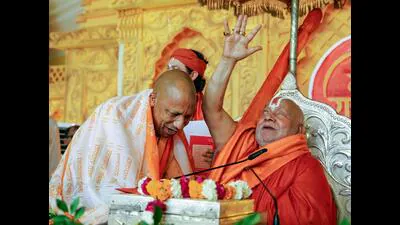
Yogi Adityanath Honors Jagadguru Rambhadracharya at Ram Katha Mahotsav

0

New Delhi, June 10, 2026: On the concluding day of the prestigious nine-day Shri Ram Katha Mahotsav, Uttar Pradesh Chief Minister Yogi Adityanath formally felicitated the revered spiritual leader Jagadguru Ramanandacharya Swami Rambhadracharya. The grand event, filled with high spiritual fervor, drew thousands of devotees, prominent religious seers, and public figures. Addressing the massive gathering, the Chief Minister emphasized the deep-rooted cultural fabric of the nation, declaring that Lord Ram’s eternal ideals continue to seamlessly unite India from north to south and east to west.

Delivering a powerful speech that blended spiritual philosophy with contemporary socio-political duties, Chief Minister Adityanath stated that listening to a holy discourse is only meaningful if individuals actively adopt its teachings into their daily lives. He praised the monumental resilience of India’s saintly traditions, highlighting how they consistently act as forces of social integration. In a stern reminder to the public, the Chief Minister warned against ongoing conspiracies meant to weaken social fabric, urging the citizens of India to remain highly vigilant and united against divisive attempts organized around caste, language, and regional identities.

Preserving India’s DNA and Civilisational Heritage

During his address, Chief Minister Yogi Adityanath made a resonant statement regarding national identity and cultural loyalty. He firmly asserted that India cannot and will not become a “dharamshala” (a transient guest house or shelter) for individuals who harbor no genuine faith in the country, its values, or its deep-rooted traditions. He noted that except for a very small fraction of people driven purely by political motivations or deep prejudices, the true “DNA of India” is directly connected to the path of righteousness exemplified by Maryada Purushottam Shri Ram.

The Chief Minister stressed that the name of Lord Ram offers an ultimate spiritual and practical solution to every modern problem. Reflecting on the profound historical significance of the Ram Janmabhoomi movement, Adityanath recalled how generations of selfless seers and saints chose to make the struggle a matter of “life and death.” He explicitly clarified that these spiritual leaders did not participate in the historic movement for personal fame or political credit; rather, their ultimate devotion was solely aimed at preserving the civilisational heritage of Sanatan Dharma for future generations.

Honoring Jagadguru Rambhadracharya’s Historic Contributions

A central highlight of the concluding ceremony was the Chief Minister’s profound praise for the scholarly and legal contributions of Jagadguru Rambhadracharya. Yogi Adityanath vividly referenced the historic 2019 Supreme Court verdict on the Ram Janmabhoomi case, noting that the Constitution Bench unanimously accepted the site as the undeniable birthplace of Lord Ram based on an overwhelming repository of evidence, historical documents, and scholarly testimonies.

The Chief Minister specifically shared an anecdote highlighting the immense impact of the Jagadguru’s expert testimony during the legal proceedings. He recalled how one of the Supreme Court judges openly remarked that after closely listening to Swami Rambhadracharya’s brilliant textual evidence, it became absolutely undeniable that the followers of Sanatan Dharma had faced systemic injustice for centuries.

Vigilance Against Demographic and Social Conspiracies

Shifting focus to immediate social challenges, Chief Minister Adityanath urged the public to maintain absolute alertness against coordinated agendas designed to disturb regional harmony. He openly called for heightened public awareness and social mobilization against modern challenges, specifically naming “love jihad,” “land jihad,” and forced religious conversion conspiracies as deliberate, underhanded attempts to alter the demographic balance of the country.

The Chief Minister pointed out that the judiciary had recognized these systemic issues long ago, referencing specific concerns raised by the Kerala High Court as early as 2009 and 2011. While noting that the Uttar Pradesh government proactive enacted strict legal measures in 2020 against unlawful religious conversions, he emphasized that laws alone cannot fully eradicate the issue. According to Adityanath, the ultimate shield against such demographic shifts relies heavily on widespread public consciousness and grassroots societal unity.

Drawing a direct parallel from the ancient Ramayana, the Chief Minister explained that negative forces emerge in every single era. He reminded the audience that Lord Ram himself took decisive action against demonic forces, like Tadaka, who aggressively sought to disrupt and destroy ancient centers of learning, research, and Vedic knowledge. In the modern context, he explained, constructive social forces and spiritual leaders must unite to defend the country’s foundational values from contemporary destructive elements.

A Call to Reject Division and Cultivate Unity

Concluding his extensive address, Chief Minister Yogi Adityanath made an earnest appeal to the citizens of Uttar Pradesh and the nation to reject internal fragmentation. He explicitly warned that modern negative forces will continually attempt to fragment Hindu society by highlighting internal differences in caste, region, and linguistic dialects. The true essence of understanding a Ram Katha, he summarized, lies in identifying these traps and choosing the path of absolute solidarity.

The Shri Ram Katha Mahotsav concluded on an elevated note of spiritual resolution, as the Chief Minister formally presented traditional honors and tokens of appreciation to Jagadguru Rambhadracharya. The massive audience responded with vibrant chants, solidifying the event not just as a religious gathering, but as a renewed cultural call to action for national preservation, mutual respect, and societal strength.

For a closer visual look at the closing day ceremony and the statements made by the leadership during this spiritual assembly, you can watch this report on Yogi Adityanath at Shri Ram Katha Mahotsav. This video features the live address delivered by the Chief Minister as he honored Jagadguru Rambhadracharya.

Nissan Gravite Prices Hiked: Why It Costs More Now

0

New Delhi, June 10, 2026: If you have been keeping an eye on the Indian automotive market for an affordable family vehicle, the Nissan Gravite has likely been on your radar. Launched in February 2026, this clever sub-four-metre, seven-seater Multi-Purpose Vehicle (MPV) instantly made waves by offering an incredibly low starting price, shaking up the budget family car segment. However, if you put off your purchase decision hoping to skip the initial waiting periods, you are now facing a brand-new reality at the dealership. Nissan India has officially rolled out its first major price revision for the Gravite lineup, making the compact people-mover noticeably more expensive across all of its variant trims.

The decision to increase prices comes just four months after the vehicle’s highly publicized national debut. When Nissan initially introduced the Gravite, it did so with highly aggressive introductory pricing that started at an eye-catching Rs 5.65 lakh (ex-showroom). Those introductory rates were intentionally designed to disrupt the market, grab consumer attention, and quickly build up a massive order bank. Now that the initial launch phase has successfully concluded and the Gravite has established a solid foothold in the market, Nissan has wrapped up those promotional rates. The new price restructuring effectively pushes the ex-showroom cost up across the board, varying anywhere from Rs 8,400 to Rs 18,400 depending on the exact trim level, transmission choice, and fuel configuration you choose.

Digging into the variant-wise breakdown reveals exactly where buyers will feel the pinch the most. For budget-conscious buyers looking at the entry-level Visia petrol manual transmission (MT) variant, the entry price has risen by Rs 8,400, officially pushing the base cost of ownership from the original Rs 5.65 lakh up to Rs 5.73 lakh (ex-showroom). Moving one step up to the Acenta MT variant, buyers will see an upward revision of Rs 9,400, bringing its price tag to Rs 6.68 lakh. Surprisingly, the most substantial financial hit lands squarely in the middle of the lineup. The mid-spec N-Connecta MT trim has received the highest price jump of the entire revision, with a flat increase of Rs 18,400. This highly popular, value-for-money variant now costs Rs 7.38 lakh, compared to its original launch price of Rs 7.20 lakh.

For those looking to skip shifting gears entirely, the automatic variants have also seen uniform adjustments. The 5-speed Automated Manual Transmission (AMT) options across the N-Connecta, Tekna, and Limited Launch Edition grades have all risen by an identical Rs 15,000. This means the N-Connecta AMT shifts up to Rs 7.95 lakh, while the fully loaded Tekna AMT climbs to Rs 8.64 lakh. Meanwhile, the premium, feature-heavy Limited Launch Edition manual variant commands a premium of Rs 17,000, bringing its sticker price to Rs 8.52 lakh. At the absolute top of the pyramid, the Limited Launch Edition AMT now maxes out the Gravite range at Rs 9.08 lakh (ex-showroom). It is also worth noting that the eco-friendly factory-fitted CNG variants, available in the Visia, Acenta, N-Connecta, and Tekna trims, have faced mirrored price jumps matching their respective petrol counterparts.

Despite the recent price hikes, the underlying mechanical formula of the Nissan Gravite remains completely unchanged. Underneath its bold exterior styling, the Gravite relies on the exact same platform and mechanical packaging as its close corporate sibling, the Renault Triber. Powering the compact seven-seater is a reliable 1.0-litre, three-cylinder, naturally aspirated petrol engine. This compact engine is tuned to deliver 71 horsepower (bhp) and 96 Newton-meters (Nm) of peak torque. Buyers can pair this motor with either a traditional 5-speed manual gearbox or a convenient 5-speed AMT system. While these power figures are modest and best suited for urban commutes and steady highway cruising rather than high-speed performance, the trade-off comes in excellent fuel economy. Nissan claims an impressive ARAI-certified mileage of 19.3 kmpl for the manual version, while the AMT version performs even better on paper, returning a claimed 19.6 kmpl.

What continues to make the Gravite an attractive packaging choice for growing Indian families is its incredible space management and feature list. Measuring just under four metres to take advantage of small-car tax benefits, the vehicle manages to squeeze in three rows of modular seating. For times when you need to haul cargo instead of passengers, the third-row seats can be completely removed, expanding the rear boot space to a massive 625 litres in a 5-seater layout. To handle the intense Indian summer heat, Nissan equipped the MPV with a heavily tropicalized air conditioning system featuring dedicated roof-mounted vents for all three rows, alongside individual blower controls for second-row passengers. The cabin also feels surprisingly upmarket for its price bracket, boasting a dual-tone dashboard accented with a faux-wooden finish, plush suede and leatherette seat upholstery, and multiple cooled storage compartments to keep drinks cold on long road trips.

On the technology and safety front, Nissan did not cut corners to meet a budget. Mid and high-spec trims come equipped with a floating 8-inch touchscreen infotainment system that supports wireless Apple CarPlay and Android Auto, a 7-inch digital instrument cluster for the driver, a wireless phone charger, automatic projector headlamps, and rain-sensing wipers. Even more impressive is the vehicle’s safety kit, which offers over 30 standard safety features across the entire range. Even if you purchase the absolute cheapest Visia variant, your car comes equipped with 6 airbags, Electronic Stability Control (ESC), a Traction Control System (TCS), Hill-Start Assist (HSA), Brake Assist, and ABS with EBD. This aggressive safety strategy helps the Gravite stand out as a highly secure option in a price segment where buyers are often forced to compromise on safety.

If you are currently holding a booking confirmation or are actively sitting on the fence about purchasing a Nissan Gravite, this price update changes the value math slightly, but it doesn’t ruin the vehicle’s core appeal. While paying up to Rs 18,400 more for the exact same car is undoubtedly a frustrating pill to swallow, the Gravite still remains one of the most practical and well-equipped 7-seater vehicles you can buy in India for under Rs 10 lakh. It continues to comfortably undercut larger MPVs like the Maruti Suzuki Ertiga while offering significantly more modern features, everyday usability, and styling panache than basic utilitarian movers like the Maruti Suzuki Eeco. Ultimately, while the introductory discount window has officially closed, the Nissan Gravite’s blend of safety, space, and efficiency ensures it remains a top contender in its class.

Senegal Football Federation Clarifies Viral Airport Security Video Ahead of 2026 FIFA World Cup

0

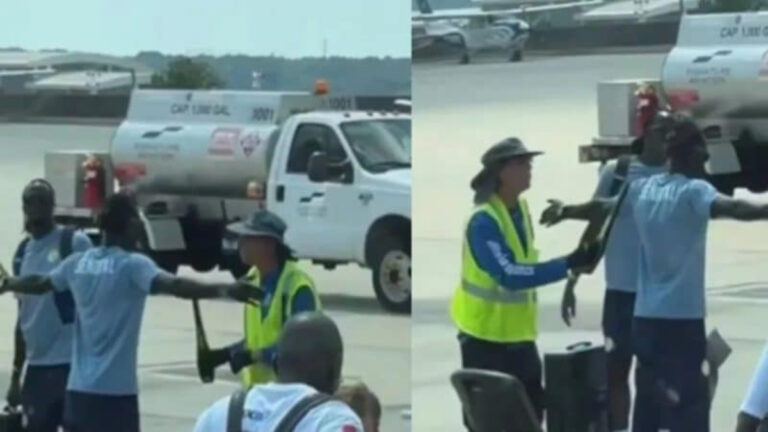
New Delhi, June 10, 2026:— The Senegal Football Federation (FSF) has officially responded to a wave of social media controversy following a viral video that showed members of the national football team undergoing security screenings on an airport tarmac in the United States. The footage, which spread rapidly across platforms like X (formerly Twitter), Instagram, and Facebook, triggered intense debate and allegations of discriminatory treatment against the African powerhouse just days before the kickoff of the 2026 FIFA World Cup.

In a comprehensive statement issued to clear up the growing misunderstandings, the FSF firmly dismissed claims that the “Lions of Teranga” were singled out or subjected to unfair treatment. The federation clarified that the footage did not capture an arrival inspection but was instead part of a pre-planned, VIP logistical arrangement designed to save travel time and maximize comfort for the squad.

The Anatomy of a Social Media Controversy

The controversy ignited when short video clips began circulating online showing high-profile Senegalese players standing on an open airport tarmac alongside their luggage. In the footage, security personnel could be seen using handheld metal detectors to screen the athletes. Online commentators and football fans quickly framed the video as evidence of “excessive” and “humiliating” scrutiny, with some accusing US airport authorities of racial profiling and questioning whether European teams were being subjected to similar checks.

The narrative attached to the viral posts claimed that the team was forced through these intense security measures immediately after landing in the US. The chaotic framing online created immediate PR friction for the tournament organizers, as the 2026 FIFA World Cup—co-hosted by the United States, Canada, and Mexico—is set to showcase global unity.

With major international stars like Sadio Mané and Kalidou Koulibaly in the squad, the footage quickly garnered millions of views and sharp criticism from fans worldwide before official sporting bodies could contextually address the situation.

What Really Happened: FSF Sets the Record Straight

According to the official statement released by the Senegal Football Federation, the viral footage was filmed on Sunday, June 7, 2026, at the Raleigh-Durham International Airport in North Carolina. Contrary to the viral rumors, the team was not arriving in the country; they were actually boarding a private charter flight heading to San Antonio, Texas, for a pre-World Cup warmup friendly match against Saudi Arabia.

The FSF explained that the tarmac security checks were part of an exclusive, expedited boarding procedure organized specifically for the delegation. Instead of forcing the squad to navigate public airport terminals, check-in desks, and crowded boarding lounges, a team bus transported the players and coaching staff directly from their hotel onto the airport tarmac.

The federation emphasized that the screening process complied fully with standard US aviation security regulations regarding private charter flights and tarmac boardings. The FSF assured fans that the entire process was orderly, routine, and conducted without any disruptive incidents or friction between the airport staff and the football delegation.

The Reality of Modern Tour Security

Aviation experts and sports travel coordinators point out that tarmac screenings are a standard practice for high-profile sports teams and dignitaries traveling on chartered aircraft. When a team bypasses the traditional Transportation Security Administration (TSA) checkpoints inside a terminal building, security protocols dictate that equivalent physical screenings must occur before passengers step onto the aircraft.

By conducting the checks at the base of the plane, the team avoided public crowds, autograph seekers, and potential security bottlenecks inside the terminal. The FSF reiterated that the arrangement was intended as a luxury logistical privilege rather than an adversarial inspection, ensuring that the athletes could travel as seamlessly as possible.

Following the smooth boarding process in North Carolina, the private charter flight operated without issue. The entire Senegalese delegation arrived safely in San Antonio, where they continued their sporting preparations on the pitch.

Focus Shifts Back to the Pitch

With the administrative distraction firmly addressed and resolved, the Lions of Teranga are turning their full attention back to football. On June 9, just after the FSF issued its clarification, a 10-man Senegalese squad fought hard to secure a goalless draw ($0\text{–}0$) against Saudi Arabia in their final warmup match in San Antonio.

Head coach Pape Thiaw is now focusing heavily on fine-tuning his strategy as the tournament approaches. Senegal enters the 2026 FIFA World Cup as one of the premier representatives from the African continent, which boasts a record 10 nations in this year’s expanded 48-team tournament layout.

The Lions of Teranga have been placed into a highly competitive Group I alongside powerhouse France, Norway, and Iraq. As the global tournament kicks off this week, Senegal’s management hopes that their organized, proactive clarification will shift the public’s focus away from viral social media speculation and back to the team’s quest for World Cup glory.

Inside the Viral Kanpur Court Marriage: A Family Disruption Turns Into Legal and Social Debate

0

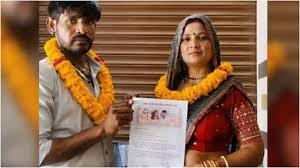
New Delhi, June 10, 2026: The boundaries of traditional family structures are frequently tested in the digital age, but a recent incident from Uttar Pradesh has pushed public discourse into unprecedented territory. In Kanpur Dehat’s Akbarpur area, a 35-year-old man reportedly dissolved his marriage with his 27-year-old wife to legally wed his 52-year-old mother-in-law. The unconventional union came to light after a video surfaced on social media showing the newlywed couple in a local court, smiling broadly, exchanging traditional garlands, and proudly displaying an official marriage certificate. The clip quickly went viral, igniting a fiery national debate regarding moral boundaries, legal loopholes, and changing societal dynamics in rural India.

The Anatomy of a Family Fracture

According to local reports and community accounts, the foundations of this unusual union began long before the court video made its way online. The man had been married to his young wife for roughly a year. What was initially expected to be a standard domestic life quickly deteriorated as a secret relationship allegedly developed between the husband and his mother-in-law during his routine visits to his in-laws’ house.

Over several months, the closeness between the two grew into a romantic involvement. Neighbors and local residents noted that the pair had been in regular, conspicuous contact, raising eyebrows within their close-knit locality. The situation reached a boiling point when the 27-year-old wife reportedly discovered the clandestine affair. Confrontations shook the household, leading to an absolute fracture of the marriage. Rather than seeking mediation or attempting to patch up the relationship, the husband and his mother-in-law took the definitive step to formalize their bond, culminating in a quiet court marriage under secular statutes.

The Viral Video and the Call for Public Acceptance

The story transformed from a private family tragedy into a massive internet sensation when the couple chose to document and share their marriage ceremony. The viral video, heavily overlayed with a romantic soundtrack specifically themed around court marriages, shows the 35-year-old son-in-law and the 52-year-old mother-in-law standing outside a court facility. They are seen smiling, ritualistically placing garlands around each other’s necks, and holding up their legal documentation for the camera.

What shocked viewers most was the couple’s direct appeal to the public. Instead of hiding their relationship from standard societal judgment, the duo looked directly into the camera to defend their union, stating that the marriage was entirely mutual, consensual, and born of personal choice. They openly asked viewers for their “blessings” and urged the public to accept their new reality. While the authenticity of the paperwork displayed is still undergoing thorough public and administrative scrutiny, the unbothered demeanor of the couple added a layer of shock value that sent the clip across major digital platforms.

Police Investigation and Legal Complexities

As the video saturated timelines and local WhatsApp groups, the intense public reaction eventually forced the authorities to step in. The Akbarpur Police Station in Kanpur Dehat launched an official inquiry into the video to verify its origins and the validity of the claims made within it. Local administrative and police officials have noted the bizarre nature of the case, but they are facing a highly distinct legal landscape.

Because the marriage appears to have been carried out by two consenting adults under a court framework, authorities have stated that no cognizable or clear criminal offense has been committed at first glance. However, legal experts are watching the development with extreme interest. Under traditional Hindu matrimonial laws, a mother-in-law falls under the category of “prohibited relationships,” which typically voids a marriage unless established customs dictate otherwise. However, because the couple claims to have opted for a secular court marriage—likely under the Special Marriage Act—the legal parameters shift completely toward individual autonomy, creating a highly complex gray area for both law enforcement and civil lawyers.

Social Media Outrage and Cultural Debate

The public reception to the viral video has been deeply polarized, serving as a mirror to India’s shifting and fractured cultural values. On one side of the digital spectrum, a massive wave of criticism, shock, and moral condemnation has flooded comment sections. Many netizens have labeled the event as a severe violation of sacred family ethics, using phrases like “the downfall of societal values” to describe how an individual could break his wife’s trust to marry her own mother. Cultural traditionalists argue that such incidents permanently damage the sanctity of domestic roles, where a mother-in-law is traditionally viewed as a maternal guardian rather than a romantic partner.

Conversely, a small but vocal minority on platforms like Reddit and X (formerly Twitter) have viewed the incident through a lens of absolute legal individualism. These commentators argue that since both participants are mature, consenting adults capable of making their own life choices, the state or public has no business intervening or moralizing over their private domestic arrangements. Others have reacted with dark humor and sheer disbelief, comparing the real-life Kanpur drama to the bizarre plotlines of prime-time television serials.

A Growing Trend of Outlandish Unions?

The incident in Kanpur Dehat is not an isolated spark; it echoes a string of increasingly unusual relationship dynamics emerging out of Uttar Pradesh that have captured national curiosity over the last few years. Local media outlets immediately drew comparisons to a highly similar case reported a few months prior in Aligarh, where a parallel son-in-law and mother-in-law romance resulted in an elopement and subsequent legal dispute.

As personal autonomy collides head-on with rigid traditional systems, and as smartphones ensure that every taboo choice is recorded and broadcasted to millions instantly, rural and semi-urban India is finding its private lives increasingly laid bare. For now, the Kanpur couple remains together, waiting for the digital storm to pass, while a baffled community and a cautious police force try to figure out how to navigate a domestic situation that has completely re-written the conventional rulebook of family life.

Chaos at Zero Point: Army-Driver Clash Sparks Outrage in Sikkim

0

June 10, 2026 — A series of viral videos capturing a violent confrontation between local taxi drivers and Indian Army personnel in the high-altitude border region of North Sikkim has sparked intense public controversy. The incident, which unfolded in the pristine but heavily congested Lachung-Zero Point tourist sector, has prompted official investigations by both civil authorities and the military.

As footage spreads rapidly across social media platforms like WhatsApp and Instagram, regional driving associations are demanding immediate accountability, while the military presents a starkly contrasting account centered around operational safety, severe traffic gridlock, and physical provocation.

Two Sides to a High-Altitude Clash

The altercation occurred along the remote route connecting Lachung, a popular tourist hub, with Zero Point—a sensitive, snow-clad alpine zone near the Indo-China border where heavy civilian tourism overlaps continuously with strategic military transit.

The Drivers’ Perspective: A Medical Emergency Ignored

According to statements issued by the local drivers’ unions—including the All Sikkim Voice of Chauffeur and the State-Level Chalak Wing of the ruling Sikkim Krantikari Morcha (SKM)—the friction began over a civilian medical emergency.

Union representatives state that a local driver, traditionally respected in the state as a Chalak Guruji or Sarathi (trusted guide), was escorting a group of tourists when a child in the vehicle fell acutely ill due to the altitude. The driver reportedly approached vehicles ahead, including an Army supply convoy, requesting they give way so the sick child could be rushed downhill for medical attention.

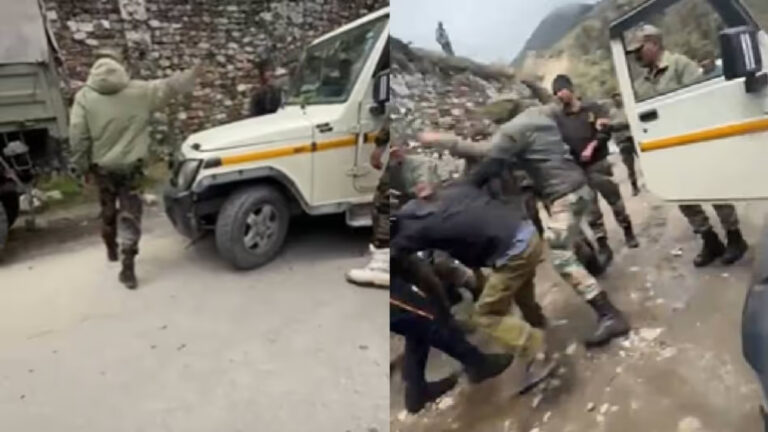
The drivers claim that this plea for passage led to an aggressive verbal response from the troops. According to their account, the situation boiled over near the Shiv Mandir area on the return route, where four local drivers were allegedly cornered and physically assaulted by uniformed soldiers. The viral videos circulating online appear to show a group of uniformed men surrounding and striking a civilian, a sight that has provoked widespread local outrage.

The Indian Army’s Perspective: Traffic Defiance and Provocation

The Indian Army has strongly disputed this narrative, presenting a vastly different sequence of events. In an official communication, military officials emphasized that Zero Point was experiencing extreme tourist congestion, which had completely gridlocked a critical operational convoy carrying essential supplies to forward border bases.

According to the Army’s counter-statement, the dispute began when a local taxi driver parked his vehicle in a manner that completely choked the narrow mountain corridor. When military personnel requested the driver to move his vehicle to clear the bottleneck, the driver allegedly refused. The Army claims that the lone driver was quickly joined by several other local operators, who collectively surrounded, physically pushed, and grabbed the uniformed personnel on duty.

While military officials state that the initial scuffle was temporarily defused to allow traffic to flow, tensions spiked again later near Shiv Mandir. When Army officers attempted to record the license plate details of the offending vehicles to lodge a formal police report, another confrontation erupted. The military alleged that at least one of the primary drivers involved was heavily intoxicated and behaving with extreme aggression—a claim currently undergoing independent verification by local medical and police examiners.

Regional Outcry and Calls for Justice

Despite the contrasting accounts, the visuals of a local driver being physically beaten have hit a deeply sensitive nerve across the mountain state. In Sikkim, where treacherous terrain makes driving highly hazardous, commercial drivers are viewed as vital community pillars rather than just service providers.

In a unified press release, the SKM Chalak Wing and the Sarathi Welfare Board strongly condemned the physical violence, highlighting the vulnerability of local workers:

To prevent the situation from escalating into wider civil unrest, State Chalak Coordinator Dichen Bhutia, alongside Lachung Station House Officer (SHO) Tilak Chettri, rushed to the high-altitude site to defuse tensions and personally review the case files.

Coordinated Investigations Underway

Recognizing the strategic and political sensitivity of a clash between civilians and security forces in a border state, both the civil administration and the military command have moved quickly to de-escalate.

The Indian Army confirmed that a formal, internal inquiry has been initiated. Military officials stated that they are actively investigating the exact sequence of events in close, transparent coordination with the local police and civil administration, promising that further details will be shared once formal verification is complete. Simultaneously, local drivers have gathered at the Lachung Police Station to officially register criminal complaints regarding the assault.

The incident highlights a growing infrastructural challenge in Sikkim’s northern frontier. Over the last decade, North Sikkim has seen an unprecedented boom in domestic tourism. Thousands of civilian vehicles scale these narrow, single-lane cliffside roads daily, directly competing for space with the heavy operational convoys of the Trishakti Corps. When extreme weather or minor accidents occur, traffic standstills lasting hours are common, creating a high-stress environment where minor road disputes can rapidly spiral out of control.

Both civil society leaders and defense analysts have noted that while the immediate priority is delivering a fair and transparent legal inquiry to satisfy local demands for justice, long-term measures are desperately needed. Local authorities are already discussing tighter regulation of tourist vehicular limits at Zero Point and the creation of dedicated military transit windows to ensure that critical defense movements and civilian hospitality can coexist safely without future friction.

An early video broadcast by a regional media outlet capturing the initial community reaction and details surrounding the Shiv Mandir altercation can be viewed via this Sikkim Driver Altercation Report. This video provides helpful local context and preliminary eyewitness perspectives from the ground in North Sikkim immediately after the incident went viral.