Home Blog Page 27

Ishita Dutta & Vatsal Sheth Reveal Daughter Veda’s Face on 1st Birthday

New Delhi, June 11, 2026: It is a moment of pure joy and celebration for one of the entertainment industry’s most loved couples, Ishita Dutta and Vatsal Sheth. On June 10, 2026, the couple’s darling daughter, Veda, turned one year old. To mark this major milestone, the doting parents decided to give their massive fanbase the ultimate birthday surprise by officially revealing their little princess’s face to the world for the first time. Taking to their respective social media handles, Ishita and Vatsal shared a heartwarming joint Instagram post filled with gorgeous pictures from Veda’s grand first birthday bash.

For the past twelve months, Ishita and Vatsal had been incredibly protective of their daughter’s privacy. Whenever they posted snippets of their family life or celebrated smaller monthly milestones, they carefully concealed Veda’s face using cute heart emojis. This boundary made the big reveal even more thrilling for their followers. The wait finally ended as the couple dropped a beautiful birthday album with a sweet, simple caption that resonated with every parent watching their child grow: “And just like that, she is one. Happy Birthday, Veda.”

A Closer Look at Veda’s Cute Cartoon-Themed Birthday Bash

The birthday pictures quickly went viral across digital platforms, with fans completely gushing over how adorable little Veda looks. For her big day, the birthday girl stole the entire spotlight dressed in a stunning, bright yellow tulle dress that made her look like a tiny princess. Her hair was styled into two precious little ponytails on either side of her head, framing her cheerful, smiling face perfectly. She looked entirely at ease and full of joy, smiling brightly for the camera as she was surrounded by the warmth of her family.

While Veda stood out in her vibrant yellow outfit, her proud parents opted for an elegant, color-coordinated look. Ishita and Vatsal beautifully twinned in matching blush-blue ensembles, adding a sophisticated yet soft aesthetic to the festive atmosphere. The birthday album also offered a sneak peek into the party’s decor and details, highlighting a magnificent, custom cartoon-themed birthday cake that perfectly suited a one-year-old’s celebration. The entire setting radiated happiness, intimacy, and love, capturing a milestone that the family will undoubtedly cherish forever.

Celebrating a Year of Beautiful Milestones and Traditions

Veda’s first birthday is the culmination of a year filled with beautiful traditional milestones for the Sheth-Dutta household. Over the last year, the parents have balanced their public lives with private family rituals. One of the most notable highlights shared with fans occurred in late 2025, when the couple hosted Veda’s traditional Bengali Annaprashan (the rice-eating ceremony).

During that auspicious event, family members from both sides gathered to shower the little one with blessings as she had her very first taste of solid food. Ishita had shared a touching glimpse of the ritual at the time, captioning it, “Veda’s first taste of rice, wrapped in blessings, love, and tradition. Bengali Annaprashan.” Moments like these have endeared the couple to millions of fans who appreciate how deeply rooted they remain in their cultural traditions.

From a Family of Three to a Complete Quad

Ishita Dutta, widely recognized for her stellar performance in the blockbuster Drishyam franchise, and Vatsal Sheth, famed for his iconic roles in Taarzan: The Wonder Car and various hit television shows, have had an incredible parenting journey. The couple first embraced parenthood in July 2023 when they welcomed their first child, a son named Vaayu.

Their happiness multiplied when they welcomed Veda into their lives in June 2025. Announcing her birth at the time, Ishita had shared an emotional picture right from the hospital room, featuring Vatsal and a curious little Vaayu looking lovingly at the newborn. The actress had beautifully penned, “From two to four hearts beating as one. Our family is now complete. Blessed with a baby girl.” A month later, they shared a glimpse of her intimate naming ceremony where they officially chose the name Veda—a Sanskrit name signifying sacred knowledge and timeless wisdom.

Balancing Motherhood, Career, and Inspiring Fitness Journeys

Beyond sharing adorable family updates, Ishita has also been highly transparent with her followers about the realistic challenges of motherhood. Recently, the actress turned heads online when she candidly spoke about her post-pregnancy fitness transformation. Ishita revealed that she managed to shed 15 kilograms within just two months through dedication and a structured routine.

Addressing the influx of questions from curious fans and fellow mothers, she stated openly that there are no shortcuts or “magical secrets” to post-pregnancy weight loss. She also opened up about the complexities of her second pregnancy, sharing that while her first two trimesters were incredibly smooth, active, and filled with travel, she was placed on strict bed rest during her sixth month due to a risk of preterm delivery. Her honesty regarding the highs and lows of pregnancy and postpartum recovery has solidified her status as a highly relatable and inspiring figure for modern mothers.

A Timeless Television Love Story Continues to Bloom

The love story of Ishita Dutta and Vatsal Sheth remains one of Indian television’s favorite real-life romances. The duo first crossed paths on the sets of the popular life OK television drama Rishton Ka Saudagar – Baazigar back in 2016. While they maintained a strict professional relationship during the shoot, feelings eventually blossomed after the show concluded. They chose to keep their relationship low-key before surprising everyone by tying the knot in an intimate ceremony at the ISKCON temple in Mumbai in November 2017.

Nearly a decade later, their bond has only grown stronger as they navigate the beautiful chaos of raising two young children together. As the news of Veda’s face reveal continues to dominate entertainment feeds, the comments sections of their social media posts have been absolutely flooded with warm blessings, love, and congratulations from fans, well-wishers, and industry colleagues alike, all welcoming baby girl Veda officially to the digital spotlight.


Noida Airport Completes Key Flight Trials: Decks Cleared for Mega Launch Next Week

0

New Delhi, June 11, 2026: The countdown has officially begun for a historic milestone in India’s aviation sector. The Noida International Airport (NIA), located in Jewar, Uttar Pradesh, successfully completed its comprehensive, full-scale aircraft turnaround trials. With this critical milestone accomplished, all technical and operational decks have been cleared for the highly anticipated launch of commercial flight operations, scheduled to commence on Monday, June 15, 2026. This greenfield aviation hub is poised to reshape air travel across the National Capital Region (NCR) and North India, operating alongside Delhi’s Indira Gandhi International Airport to significantly ease regional air traffic congestion.

The successful exercise was conducted as a central part of the airport’s intensive Operational Readiness, Activation, and Transition (ORAT) programme. Carried out in close collaboration with IndiGo—the airport’s primary launch carrier—and various key aviation stakeholders, the trial simulated a seamless, end-to-end aircraft turnaround on the airside. A commercial IndiGo aircraft was utilized to rigorously evaluate the real-world coordination, responsiveness, and integration of the airport’s technological systems, physical infrastructure, and ground personnel.

According to official statements from the airport authorities, the extensive drill validated a wide array of critical infrastructure. This included the automated Visual Docking Guidance Systems (VDGS), which provide pilots with precise digital displays to park safely at terminal gates, alongside passenger boarding bridges and ground power units. The simulated process also extensively tested integrated baggage handling mechanisms, air cargo systems, and in-flight catering services. Additionally, ground crews successfully evaluated aircraft refueling workflows under stringent operational timelines. Crucially, the exercise facilitated the final re-validation of the airport’s Instrument Landing System (ILS) and Required Navigation Performance (RNP) approach procedures, guaranteeing that the runway is fully optimized for precision landings under all weather conditions.

The upcoming commercial launch on June 15 marks the culmination of years of massive infrastructure development. Developed by Yamuna International Airport Private Limited—a wholly-owned subsidiary of Zurich Airport International AG—Phase 1 of the mega-project represents an investment of approximately ₹11,200 crore. Tata Projects spearheaded the engineering and construction of the facility, which features a massive 3,900-meter runway capable of handling major wide-body aircraft. The state-of-the-art passenger terminal is built to accommodate up to 12 million passengers annually in its initial phase, with master plans in place to scale capacity up to 70 million travelers per year as future expansion phases roll out.

Beyond its sheer scale and technological prowess, the Noida International Airport stands out for its unique architectural and environmental identity. The passenger terminal features open internal spaces, courtyards, and entrance areas beautifully inspired by traditional Indian river ghats and heritage havelis, providing travelers with a culturally immersive and relaxed transit environment. Furthermore, the airport has earned praise for its strict environmental sustainability benchmarks; it is India’s first large-scale infrastructure project to extensively utilize low-carbon limestone calcined clay cement, moving the facility aggressively toward a net-zero carbon emissions goal.

The initial rollout of commercial operations will focus primarily on domestic passenger flights and cargo logistics. Following the inaugural flight next week, major domestic carriers including IndiGo, Akasa Air, and Air India Express will rapidly establish direct connectivity between Jewar and major metropolitan hubs across India. Within the first month of operations, passengers will be able to book direct flights to key cities such as Bengaluru, Mumbai, Hyderabad, Lucknow, and Navi Mumbai, with the network expanding to 15 domestic destinations shortly thereafter. International flight operations are projected to follow later in the year, tentatively by September, allowing the airport’s round-the-clock domestic systems to fully stabilize first.

Recognizing that smooth ground accessibility is vital to the airport’s success, local and national authorities have executed a comprehensive regional mobility plan. A newly constructed 750-meter direct link road seamlessly connects the terminal building straight to the Yamuna Expressway, ensuring that travelers coming from Delhi, Noida, or Agra can entirely bypass local village roads. For last-mile connectivity, the airport management has partnered with major app-based ride-hailing services. Additionally, an all-electric airside and landside taxi fleet will be deployed, complemented by dedicated public bus routes connecting the terminal to over 25 cities across Uttar Pradesh, as well as direct highway shuttles to Gurugram, Faridabad, and Panipat in Haryana. Looking to the future, the National Highways Authority of India (NHAI) has also initiated feasibility studies for a high-speed underground transit tunnel designed to directly link Delhi’s IGI Airport and the new Noida International Airport, minimizing travel times between the twin aviation hubs.

The operationalization of the Jewar airport is expected to serve as a massive economic catalyst for the entire region. Beyond offering immediate relief to the heavily congested skies of Delhi, the airport has already triggered an unprecedented real estate and industrial boom along the Greater Noida and Yamuna Expressway corridors. Global tech firms, manufacturing entities, and massive logistics hubs are rapidly setting up operations in the surrounding industrial zones to capitalize on the multi-modal connectivity. The aviation hub is expected to generate tens of thousands of direct and indirect jobs, boosting tourism, commerce, and regional development across western Uttar Pradesh.

Also Read: Silicon Valley Shifts Gears: Opendoor Shuts Down India Hub in AI-Native Restructuring

With the Directorate General of Civil Aviation (DGCA) having already granted the mandatory aerodrome license earlier this year, and the final airside turnaround trials concluding flawlessly, the facility is entirely prepared for its grand debut. The successful trial confirms that the human elements, digital frameworks, and mechanical systems are working in perfect harmony. When the first commercial flight touches down next week, it will signify the dawn of a new era for Indian aviation, positioning the Noida International Airport as a world-class gateway to the world.

Silicon Valley Shifts Gears: Opendoor Shuts Down India Hub in AI-Native Restructuring

0

New Delhi, June 11, 2026 — In a move that has sent shockwaves through both the American property technology (proptech) sector and India’s outsourcing industry, Opendoor Technologies has announced the complete shutdown of its Indian operations. The real estate tech giant is laying off its entire 250-member workforce across its tech hubs in Chennai and Bengaluru.

The announcement, delivered by Opendoor’s Chief Executive Officer Kaz Nejatian via an internal memo and publicly shared on social media platform X, signals a dramatic pivot in how Silicon Valley firms plan to structure their global workforces. The core rationale behind the move? A deliberate push to bring operations back home, heavily augmented by artificial intelligence.

“Our customers are in America, and that’s where our operational work belongs,” Nejatian stated plainly.

The decision marks a definitive end to the company’s offshore backend model, transferring the remaining operational roles directly back to the United States to be managed by smaller, localized teams integrated with AI automation.

The Evolution of “Opendoor 2.0”

For years, Opendoor functioned under a traditional tech playbook: hiring a massive engineering and operational workforce in India to manually manage fragmented data, track home renovations, and stitch together disjointed internal software platforms.

However, the launch of the company’s structural overhaul—dubbed Opendoor 2.0—fundamentally altered that math. Over the past few months, the company has quietly migrated pieces of its backend infrastructure back to the United States. This sudden final step entirely winds down the Indian business hub, leaving only a tiny, temporary skeleton crew to handle the immediate transition of remaining data pipelines.

According to the leadership team, the restructuring is designed to enforce three massive operational shifts:

  • Radical Simplification: Eradicating the messy web of individual point-solution software tools, complex manual workarounds, and multi-step processes that previously required human oversight.
  • A Unified Experience: Constructing a single, centralized data platform that tracks a home’s entire lifecycle—from the initial cash offer and physical renovation to final listing and sale—visible to any remaining employee.
  • An Earned Blueprint: Stopping the practice of stacking manual workflows on top of failing legacy software. Moving forward, every single new operational process must strictly prove its automated efficiency to even exist.

The Intersection of AI and Onshoring

While corporate messaging framed the migration as a customer-centric move to bring data operations closer to American real estate buyers, industry analysts quickly identified a much larger force at play: the rapid maturity of enterprise artificial intelligence.

By substituting human-driven manual workflows with advanced AI models capable of processing property documentation, evaluating repair costs, and managing customer inquiries, the traditional cost-arbitrage argument for keeping large teams in India has begun to break down. Nejatian explicitly noted that Opendoor has spent the last year hiring “small, AI-native, customer-facing teams throughout the US.”

With automation handling the repetitive grunt work, these smaller domestic teams can manage a much broader scope of responsibilities than before. The company’s global footprint had already been shrinking prior to this announcement; securities filings show Opendoor’s workforce dropped from 1,470 employees down to just over 1,000, with its international headcount experiencing the sharpest cuts. Wall Street responded favorably to the lean infrastructure approach, with Opendoor’s stock climbing roughly 8% following the announcement.

A Watershed Moment for Global Outsourcing?

Opendoor’s sudden exit from India has triggered a fierce debate across social media and tech boards regarding the future of offshore back-office operations. For three decades, India has reigned as the premier destination for Western tech firms looking to scale operational capacity cost-effectively. However, tech experts suggest Opendoor’s strategy could represent a structural turning point in software operations.

Public reaction, however, remains deeply polarized. While some market spectators praised the push to return operational jobs to American soil, critics online called out the corporate optics. Many pointed out the irony of a company framing the abandonment of an offshore workforce—which it spent years building—as a sudden, virtuous commitment to local American labor, rather than an opportunistic cost-cutting measure enabled by AI.

Softening the Blow for Impacted Workers

To his credit, Nejatian took pains to emphasize that the layoffs were entirely a structural business decision and bore no relation to the performance or talent of the local team. The internal memo lauded the Indian engineers and data specialists for doing “meaningful work” that helped build the foundation of the modern platform.

To assist the 250 displaced workers, Opendoor announced it is distributing transition packages that feature:

  1. Extended financial severance.
  2. Dedicated corporate outplacement services to match individuals with new roles.
  3. Continued access to localized healthcare resources during the transition period.

In an unusual move for a tech executive executing layoffs, Nejatian actively transformed his social media announcement into an open recommendation letter, publicly calling on active tech recruiters and local Indian enterprises with a presence in Chennai or Bengaluru to snap up the departing talent. “If you’re hiring and have a presence in India, these are excellent people,” the CEO wrote. “Consider this my reference letter and hire them.”

As corporate America watches the outcome of the Opendoor 2.0 experiment, the broader tech landscape faces a lingering question. The true test over the coming year will be whether a hyper-lean, AI-native domestic workforce can effectively manage the unpredictable complexities of the US housing market without a robust backend support team overseas.

iPhone 18 Pro Max: 5 Massive Upgrades Leaked

0

New Delhi, June 11, 2026: The tech world is buzzing with excitement as Apple prepares to unveil its highly anticipated next-generation flagship, the iPhone 18 Pro Max. While the official reveal is slated for the company’s traditional autumn event, a massive wave of credible supply chain leaks has already painted a incredibly vivid picture of what to expect. This year, Apple is not just offering an incremental, routine refresh. Instead, the tech giant is reportedly engineering some of the most profound hardware shifts in the device’s history, targeting meaningful improvements in processing raw power, cellular technology, camera mechanics, and endurance. Driven by a desire to supercharge “Apple Intelligence” and secure its premium smartphone dominance, Apple looks ready to introduce five massive, game-changing upgrades to its top-tier Pro Max model.

The undisputed crown jewel of the upcoming iPhone 18 Pro Max upgrades is the introduction of the A20 Pro chipset. This processor marks a monumental technological milestone as Apple’s very first mobile silicon manufactured on TSMC’s cutting-edge 2-nanometer (2nm) process. In plain terms, shrinking the chip architecture allows engineers to cram billions of additional transistors into an incredibly tiny space. Industry insiders indicate that this translation to 2nm technology will yield a 15% increase in CPU speed alongside a massive 30% reduction in power consumption compared to the previous generation. To further maximize this performance, Apple is rumored to be using an advanced Wafer-Level Multi-Chip Module (WMCM) packaging method, which integrates a rumored 12GB of RAM directly into the main system-on-chip setup. This structural powerhouse is intentionally designed to handle heavy, on-device artificial intelligence tasks locally, ensuring that complex generative AI features run instantly without causing thermal throttling or overheating.

Beyond the internal brainpower, the physical face of the iPhone 18 Pro Max is set to get a much-welcomed visual redesign. Since its introduction, the pill-shaped “Dynamic Island” cutout at the top of the display has eaten into valuable screen space. For the iPhone 18 Pro Max, Apple is reportedly shrinking this interface element significantly. Renowned tipsters suggest that Apple has successfully relocated some of the complex Face ID sensors—specifically the flood illuminator components—directly underneath the display glass. This engineering feat allows the visible camera cutout to shrink by an estimated 35%, making it noticeably narrower and far less intrusive. When paired with a massive 6.9-inch display utilizing energy-efficient LTPO+ panel technology, users will enjoy a cleaner, highly expansive view with significantly increased peak screen brightness, giving the phone a remarkably futuristic, bezel-free appearance.

Also Read: Escalation in the Gulf: India Protests as US Military Disables Second Tanker in One Week

Turning the device over reveals what industry analysts are calling one of the most radical camera updates in modern smartphone history. Apple is reportedly breaking away from fixed optics by introducing a mechanical variable aperture system to the main 48-megapixel Fusion camera. This revolutionary hardware upgrade allows the camera lens to physically expand or contract, manually adjustment how much ambient light enters the sensor. Photographers can utilize a wide, shallow depth of field to isolate subjects with natural, blurry backgrounds, or step down to a deeper focus for perfectly sharp landscapes. Furthermore, both the main and telephoto lenses are expected to receive wider apertures across the board to heavily minimize image grain and maximize details during nighttime or low-light shooting. Rumors also hint that Apple is testing a sophisticated three-layer stacked image sensor sourced from Samsung to dramatically enhance overall dynamic range and image capture responsiveness.

In tandem with these external innovations, Apple is finally breaking its reliance on third-party network chips by debuting its own custom-built cellular modem, codenamed the Apple C2. This second-generation in-house modem represents years of secret research and development, and it aims to deliver dramatically superior network stability, faster 5G download speeds, and significantly reduced battery drain when searching for weak signals. Perhaps the most exciting aspect of the C2 modem is its rumored expansion into true consumer-facing satellite connectivity. While previous iterations limited satellite capabilities strictly to emergency SOS texts, the iPhone 18 Pro Max is rumored to support actual web browsing, navigation mapping, and photo sharing entirely over satellite networks, offering a vital communication lifeline when users travel entirely off the grid.

Finally, all of these power-hungry internal components will be supported by what is being teased as the longest-lasting battery ever packed into an iPhone. The physical footprint of the iPhone 18 Pro Max is expected to become slightly thicker, measuring roughly 8.8mm to comfortably accommodate a larger physical battery cell rumored to sit between 5,100mAh and 5,200mAh. When you combine this physically larger fuel tank with the 30% efficiency savings of the 2nm A20 Pro chip, the power savings of the new LTPO+ display panel, and the optimization of the custom C2 modem, early estimates point toward a true “two-day” battery life. To top it all off, Apple is complementing this internal overhaul with stunning aesthetic adjustments, leading with an ultra-premium “Dark Cherry” deep wine-red hero color, alongside classic Cloud Blue and Dark Gray tones, all utilizing an updated matte rear glass formulated to blend seamlessly into the anodized aluminum frame for a striking, monolithic design.

Escalation in the Gulf: India Protests as US Military Disables Second Tanker in One Week

0

New Delhi, June 11, 2026 — Tensions in the Middle East have dramatically spilled over into international shipping lanes after the United States military carried out back-to-back airstrikes against commercial oil tankers in the Gulf of Oman. The strikes, executed as part of an aggressive US-led naval blockade against Iranian ports, have triggered a diplomatic standoff between Washington and New Delhi. While the US maintains it is enforcing strict economic blockades, Indian authorities have issued strong condemnations after dozens of Indian seafarers were caught in the crossfire, leaving three sailors missing at sea.

Dramatic video footage has captured the moments when advanced American fighter jets fired precision guided missiles directly into civilian merchant vessels. The videos, which have rapidly circulated on global maritime networks and social media platforms, show thick plumes of black smoke billowing into the sky from the vessels’ shattered engine compartments as military helicopters circle above to coordinate emergency evacuations.

The U.S. Blockade and the Strategy of “Precision Disabling”

According to the US Central Command (CENTCOM), the strikes are part of a targeted enforcement mechanism deployed after Iran severely restricted maritime traffic through the vital Strait of Hormuz. In response, Washington initiated a sweeping blockade of all Iran-related shipping.

The military strategy utilized by the US Navy in these incidents involves “precision disabling”—firing heavy munitions specifically into a vessel’s engine room and steering mechanics to neutralize its propulsion without sinking the entire ship or causing a catastrophic oil spill.

The recent crisis developed across two distinct engagements within less than 72 hours:

  • The Attack on the MT Marivex: On Monday, a US Navy F/A-18 Super Hornet, launched from the aircraft carrier USS Abraham Lincoln, fired on the Palau-flagged tanker MT Marivex. CENTCOM stated that the ship was attempting to evade the US blockade for a fourth time to reach an Iranian port. After ignoring multiple verbal warnings to turn around, its engine and steering spaces were targeted, causing a massive fire.
  • The Strike on the Settebello: On Tuesday evening, a nearly identical strike crippled a second Palau-flagged oil products tanker, the Settebello, approximately 20 nautical miles northeast of Sohar, Oman. US forces targeted the engine room with precision ordnance, asserting the ship had violated the ongoing blockade by attempting to transport Iranian fuel.

Indian Crews Caught in the Crossfire

While the targeted tankers are registered under foreign flags, both ships relied entirely on Indian merchant mariners to operate. The consecutive strikes have placed civilian Indian sailors directly in the line of military fire, turning a geopolitical struggle between Washington and Tehran into an urgent humanitarian emergency for New Delhi.

During the first strike on the MT Marivex, all 24 Indian nationals on board managed to survive. The crew abandoned the burning ship and was rescued via an emergency airlift coordinated by Omani military helicopters before being safely transported to Oman’s Masirah Island.

However, the second strike on the Settebello resulted in casualties. While a rapid search-and-rescue operation successfully pulled 21 Indian sailors from the burning vessel, three Indian seafarers remain missing. Rescue vessels and local Omani authorities are scouring the Gulf of Oman to locate the lost crew members, though hopes are dimming given the intensity of the engine room explosion and the resulting fire.

Diplomatic Fallout: India Summons US Envoy

The strikes have sparked a sharp rift between India and the United States, two nations that typically maintain close strategic and maritime ties. Following the strike on the Settebello and the disappearance of the three citizens, India’s Ministry of External Affairs (MEA) moved from quiet concern to public condemnation.

New Delhi formally summoned US Charge d’Affaires Jason Meeks to lodge a “strong protest” over the military action taken against commercial vessels staffed by Indian citizens. In an official statement, the MEA characterized the recurring attacks as deeply worrisome and entirely unacceptable.

International bodies have echoed India’s sharp rebuke. Arsenio Dominguez, the Secretary-General of the International Maritime Organization (IMO), strongly condemned the military action, emphasizing that the safety of innocent seafarers must remain a baseline priority under global law, regardless of the sanctions in place.

The Economic Context: The “Shadow Fleet”

Shipping data reveals that the vessels targeted belong to what global economists refer to as the maritime “shadow fleet”—a network of older, foreign-flagged tankers that operate under complex corporate structures to transport sanctioned oil from countries like Iran and Russia.

Because these ships frequently change names, disable their mandatory automatic tracking transponders, and hide their true ownership, they present a massive challenge for Western authorities trying to enforce financial blockades. However, the crews hired to sail these high-risk routes are almost always civilian mariners from developing nations, particularly India, the Philippines, and Bangladesh, who take on the dangerous voyages for employment.

What Lies Ahead for Global Shipping?

The deployment of direct airstrikes by US warplanes against merchant vessels represents a significant escalation in maritime warfare tactics. Previously, blockades were enforced through physical interceptions, boarding parties, or financial asset seizures. By resorting to kinetic missile strikes inside international waters, the US has signaled a zero-tolerance policy toward the transport of Iranian oil, even at the risk of fracturing alliances with neutral trading partners like India.

For India, the immediate priority remains the search-and-rescue operation for the three missing sailors off the coast of Sohar. Beyond the rescue efforts, the incident is forcing a major re-evaluation of maritime security for thousands of Indian seafarers working in the Middle East. With the Strait of Hormuz and the Gulf of Oman turning into active combat zones, commercial shipping lanes face severe disruptions, threatening to drive up global oil prices and insurance premiums for merchant vessels worldwide.

Gym Firing: Bishnoi Gang Targets Guru Randhawa

New Delhi, June 11, 2026: The national capital was rocked by yet another brazen display of gang violence when two unidentified, bike-borne gunmen opened fire at a high-end fitness center in West Delhi. The targeted establishment, a “24 HRS Fitness” gym located in the Pushkar Enclave area of Paschim Vihar, has been heavily linked to the popular Punjabi singer and actor Guru Randhawa. Almost immediately after the incident, a prominent member of the notorious Lawrence Bishnoi gang claimed responsibility for the attack. The gang cited Randhawa’s growing proximity to Bollywood superstar Salman Khan as the primary motive for the shooting, escalating an ongoing feud that has kept law enforcement agencies across multiple states on high alert.

The Early Morning Ambush in Paschim Vihar

The terrifying incident occurred during the quiet, early morning hours when most residents were just beginning their day. According to official statements released by the Delhi Police, a Police Control Room (PCR) call was franticly received at the Paschim Vihar East police station reporting that gunshots had been fired at the 24 HRS Fitness center.

Witnesses and initial site verifications confirmed that two masked men riding a motorcycle slowed down in front of the gym. Without warning, the pillion rider pulled out a firearm and discharged multiple rounds directly at the establishment. At least one heavy-caliber bullet shattered the massive glass facade of the gym, scattering shards across the entrance. Because the attack took place so early in the morning, foot traffic inside and outside the facility was minimal. Miraculously, no injuries or casualties were reported, though the psychological impact on the staff and local residents has been profound.

Bishnoi Gang Issues Chilling Warning Over “Salman Khan Closeness”

Within hours of the shooting, the digital footprint of the underworld became visible. An overseas associate of the Lawrence Bishnoi syndicate, identifying himself as Anil Pandit (a U.S.-based gangster) and backed by other gang affiliates like Randeep Malik, took to social media and audio channels to openly claim credit for the operation.

The gang explicitly stated that the franchise was targeted because it is owned by or deeply associated with Guru Randhawa. In a chilling message posted across social media networks, the group stated that they carried out the hit as a direct warning to the Punjabi pop star. The message alleged that Randhawa has been “getting very close” to actor Salman Khan, an individual whom Lawrence Bishnoi has publicly sworn to eliminate due to a decades-old religious and personal grievance over a blackbuck poaching case.

The gang referred to the early morning shooting as a mere “trailer,” implying that if their warnings were ignored, the consequences for the singer and his business ventures would be far more severe. Underworld sources also noted that the gang tried to establish contact with local individuals managing the establishment, warning that “ignoring calls” from their syndicate would result in deadly outcomes.

The Ongoing Threat Matrix: Targeting Salman Khan’s Circle

This recent assault in Delhi is not an isolated incident; rather, it represents a continuation of the Bishnoi gang’s aggressively expanding campaign against Salman Khan and anyone within his immediate social or professional orbit.

The feud reached a fever pitch in April 2024, when shooters linked to the same criminal syndicate opened fire outside Salman Khan’s Galaxy Apartments residence in Bandra, Mumbai. Since then, the gang has consistently targeted individuals, businessmen, and public figures who publicly support or maintain close personal ties with the Bollywood actor. By expanding their crosshairs to include national icons like Guru Randhawa, the syndicate is attempting to project absolute dominance and demonstrate that their operational reach spans seamlessly across state lines—from Mumbai and Punjab to the heart of New Delhi.

Active Police Investigation and Ground Reality

In the wake of the gunfire, specialized units of the Delhi Police, including the Outer Delhi division and the Anti-Narcotics and Special Cell teams, swarmed the crime scene. Forensics teams collected bullet casings left behind by the fleeing perpetrators, while investigators began mapping out the escape route used by the gunmen.

A major hurdle emerged early in the investigation: the shooters deliberately positioned themselves just outside the direct range of the gym’s primary exterior closed-circuit television (CCTV) cameras. However, police units are actively reviewing data from a wider network of municipal and private cameras along the Paschim Vihar escape route to uncover the registration details of the motorcycle.

Simultaneously, the police are conducting a deep dive into the financial and structural ownership of the fitness franchise. While gang communication explicitly named Guru Randhawa as the target, senior police officers noted that they are verifying the exact nature of the singer’s business stakes in this specific West Delhi branch. Authorities are investigating whether the attack was primarily a highly publicized warning regarding his celebrity associations, or a masked attempt at running an extortion racket against high-profile commercial properties in the capital.

Security Intensified for Public Figures

The brazen nature of the attack has sent shockwaves through both the entertainment industry and the local business community in Delhi. The fact that an international criminal network can seamlessly orchestrate a drive-by shooting in a bustling residential and commercial hub like Paschim Vihar has raised serious concerns regarding public safety and the enforcement of law and order.

In response to the direct threats issued via the gang’s social media communiqués, security protocols around Guru Randhawa are being reviewed and heavily fortified. Law enforcement agencies are taking no chances, given the syndicate’s violent track record. Elite units continue to hunt down the localized operational elements responsible for pulling the trigger, working vigorously to dismantle the network before another warning escalates into tragedy.

The Promise of Home: Why Radhika Ambani Chose India Growth Over US Turmoil

New Delhi, June 11, 2026: In a candid reflection on her formative years, Radhika Ambani (née Merchant) has opened up about the pivotal moments that led her to leave the United States and return to India. Speaking at the headquarters of India’s International Movement to the United Nations (IIMUN), the younger daughter-in-law of billionaire industrialist Mukesh Ambani shared an inspiring perspective on national pride, economic momentum, and a concept she calls “emotional infrastructure.” Her remarks offer a unique window into the minds of young, overseas-educated Indians who are increasingly choosing to build their futures at home rather than chasing the traditional American Dream.

A Tale of Two Nations: Volatility vs. Opportunity

For Radhika, who studied Political Science at New York University (NYU), the choice to return to India was solidified by the stark contrast between the political landscapes of both countries at the time. When she was finishing her studies, Donald Trump was ascending to the U.S. presidency for his first term.

While the United States was navigating a period of deep political polarization and societal friction, India was moving in a radically different direction. Back home, the Bharatiya Janata Party (BJP) had secured a strong government mandate, signaling a period of prolonged political stability. For a political science student, the juxtaposition was impossible to ignore. One nation felt fractured and unpredictable, while the other seemed to be gathering its strength for a massive developmental leap.

The Madison Square Park Turning Point

While living in New York, one specific event completely reshaped Radhika’s outlook on India’s future. She attended Prime Minister Narendra Modi’s massive community rally at Madison Square Garden. Witnessing the immense energy, the optimism of the diaspora, and the forward-looking vision articulated on that global stage changed everything for her.

The rally highlighted a booming macroeconomic reality. Radhika noted that India’s economy was accelerating at an impressive growth rate of around 8.5%, while the United States was growing at a much more modest 2% to 3%. For a young graduate looking to make a meaningful impact, the math was simple: India was where the action was. It was no longer a developing nation to be left behind, but an economic engine full of untapped possibilities.

Digital Evolution and Infrastructure

Beyond pure GDP numbers, Radhika was deeply impressed by the rapid modernization of India’s public infrastructure. The country was undergoing a digital revolution that was entirely redefining daily life and commerce. The rollout of foundational systems transformed India into one of the most technologically progressive environments in the world.

  • Aadhaar & UPI: The world’s largest biometric ID system combined with the Unified Payments Interface (UPI) modernized digital banking, making instant transactions accessible to hundreds of millions.
  • The Jio Effect: The launch of Reliance Jio democratized data, bringing affordable internet access to every corner of the country and sparking a massive tech boom.

Seeing these structural changes from afar made her realize that India was equipping its citizens with tools that rivaled, and in some cases surpassed, Western digital frameworks. The momentum felt tangible, and the country was visibly evolving into a global powerhouse.

Building on ‘Emotional Infrastructure’

Perhaps the most resonant part of Radhika’s reflection was her introduction of the concept of “emotional infrastructure.” While structural assets like highways, high-speed rail, and modern airports are critical for an economy, she argued that they are secondary to the human networks that sustain us.

For Radhika, returning home meant plugging back into a foundational network of family, culture, and community support. She emphasized that true personal and professional fulfillment comes from creating value in a place where you have deep roots, surrounded by the people who invested in your growth.

A Moral Responsibility to the Nation

Today, Radhika serves as the Executive Director on the board of Encore Healthcare, her family’s pharmaceutical firm, and has fully integrated into her role within the Ambani family. Ultimately, her choice to return wasn’t just driven by financial prospects or corporate career paths; it was a decision rooted in personal values.

She concluded her address by sharing a deep-seated sentiment shared by an entire generation of returning expats: a profound sense of duty. “As a person, it depends on your moral standing. Like I had a huge feeling of responsibility to build for the country,” she stated.

Her journey stands as a powerful testament to India’s shifting global perception. For decades, the narrative was dominated by “brain drain,” where India’s brightest talent permanently migrated westward. Now, stories like Radhika’s showcase a growing trend of “brain gain”—where young leaders return home, driven by powerful economic opportunities, robust digital ecosystems, and an undeniable desire to shape the future of their own nation.

TRAGEDY ON THE GODAVARI: OVERCROWDED PILGRIM BOAT CAPSIZES IN MAHARASHTRA BEED DISTRICT

0

New Delhi, June 11, 2026: A spiritual journey turned into a scene of horror and chaos on Wednesday morning when an overcrowded boat carrying dozens of pilgrims capsized in the Godavari River. The tragic incident occurred near the prominent Purushottampuri temple area in the Majalgaon tehsil (administrative block) of Maharashtra’s Beed district.

Initial official reports confirmed that at least two women drowned in the mishap, while several other devotees sustained serious injuries. Dozens of passengers, including men, women, and children, were flung into the deep waters but were successfully pulled to safety by the swift and heroic actions of local villagers and rescue teams.

The Incident: A Sudden Disaster Midstream

The accident took place between 10:00 AM and 11:00 AM on Wednesday, June 10. The Godavari River was bustling with religious activity due to the auspicious ongoing holy month of Adhik Maas (also referred to as Purushottam Maas). The Purushottampuri temple, located roughly 20 to 25 kilometers from Majalgaon, is a highly revered destination as it houses the only shrine in India completely dedicated to Lord Purushottam. Thousands of devotees from across Maharashtra and neighboring regions had gathered at the riverbank to take a ritual holy dip before crossing the river to offer prayers at the temple.

Because the temple sits on the opposite bank, crossing by ferry is a standard and necessary routine for pilgrims. Witnesses reported that local boat operators, looking to maximize profits during the heavy morning rush, ignored basic safety guidelines.

According to preliminary administrative data, the ill-fated boat had an official safety license to carry a maximum of 20 passengers. However, operators reportedly crowded between 35 and 50 passengers onto the vessel. Eyewitness accounts described the boarding process as chaotic, with passengers packed tightly together.

As the heavily weighed-down boat reached the deeper, midstream currents of the Godavari River, the unequal distribution of weight caused it to lose balance. Within moments, the vessel listed sharply to one side and overturned completely, throwing everyone on board into the deep, fast-flowing river.

Heroic Rescues and Casualties

The sudden capsizing triggered instant panic. The air filled with desperate cries for help as victims struggled to stay afloat in the deep water. Fortunately, the accident occurred within sight of the riverbanks. Local youth, fishermen, and villagers standing nearby acted with incredible bravery and presence of mind. Without waiting for official emergency response teams, dozens of locals immediately dove into the river to pull people out.

Shortly after, local police personnel and district disaster management teams arrived at the site to formalize the rescue mission. The joint efforts managed to save the vast majority of the passengers. However, two lives could not be saved.

  • Pramila Sheshrao Rathod (54-55 years old), a resident of Lonar in the Buldhana/Washim district region. Hindustan Times
  • Kantabai Dyandev Andhale (53-60 years old), also traveling from the Washim district. Hindustan Times

Additionally, a 75-year-old devotee identified as Sindhubai Arjun Mavale was pulled from the river in an unconscious condition. Emergency responders rushed her to a private hospital in Majalgaon, where medical professionals reported her condition to be highly critical. The remaining injured survivors were admitted to nearby government and private healthcare facilities, where they are currently receiving treatment for shock, water inhalation, and minor physical trauma.

Public Anger Outbreak and Repeated Warnings

The tragedy has sparked massive public outrage against local administrative officials and commercial boat operators. Local residents and survivors allege that this disaster was entirely preventable and stems from a long-standing history of institutional neglect.

Shockingly, this is not an isolated event for the region. This capsize marks the third major water-safety incident along this specific stretch of the Godavari River within a single month:

  1. May 19: A local youth tragically drowned after venturing into the deep waters of the river. Hindustan Times
  2. Early June: Another boat carrying devotees overturned near the banks. Miraculously, there were no casualties in that incident because alert locals managed to pull everyone out in time. PTC News

Despite these clear, recurring warning signs, residents argue that the district administration failed to implement basic, common-sense safety protocols. Devotees point out that there was absolutely no enforcement regarding mandatory life jackets for commuters, nor were there any official checks to monitor and cap the maximum number of passengers entering the boats during high-traffic religious festivals.

Official Response and Higher-Level Inquiry

Following the disaster, Beed District Collector Vivek Johnson rushed to the accident spot to supervise the rescue operations, visit the survivors in the hospital, and comfort grieving family members. Acknowledging the clear lapse in safety and the severe overloading of the boat, the District Collector promised that strict punitive actions would be taken against anyone found guilty of negligence.

The local police have officially registered a criminal case against the boat operators and organizers under relevant sections of the law regarding endangerment of life and rash, negligent behavior.

Moving Forward: The Need for Strict Water Safety

As the holy Adhik Maas festival continues, thousands more pilgrims are expected to visit the Purushottampuri temple over the coming weeks. The district administration faces immense pressure to drastically overhaul crowd-management and river-crossing safety protocols immediately.

Safety experts emphasize that the administration must move away from reactive measures and deploy permanent enforcement officers at all active ferry points. Mandating high-quality life jackets for every passenger, establishing physical barricades to count and control boarding numbers, and strictly licensing only certified boat operators are crucial steps required to restore public confidence and protect human life.

For now, an aura of grief hangs over the sacred grounds of Purushottampuri, serving as a somber reminder of how commercial greed and administrative lapses can instantly turn a day of devotion into a day of mourning.

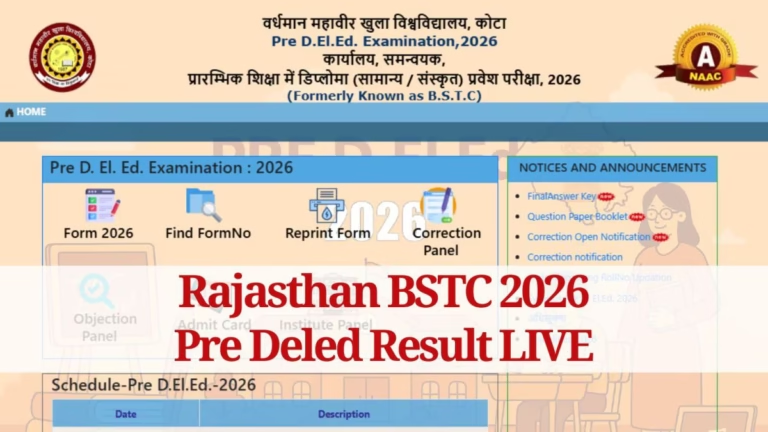
Rajasthan BSTC Pre D.El.Ed Result 2026 Declared

0

New Delhi, June 10, 2026: The Vardhman Mahaveer Open University (VMOU), Kota, has officially declared the results for the Rajasthan Basic School Teaching Course (BSTC) Pre Diploma in Elementary Education (Pre D.El.Ed) entrance examination. Candidates who have been anxiously waiting to check their performance can now access and download their scorecards directly from the official web portal at predeledraj2026.com.

The high-stakes state examination results were formally announced by the state’s Education Minister, Madan Dilawar, during a press briefing at the Jaipur Regional Centre of VMOU. The announcement event was presided over by the main coordinator and Vice-Chancellor of the university, Professor B.L. Verma. Although initially scheduled for release at precisely 3:00 PM, a brief technical delay kept candidates on the edge of their seats before the portal servers went fully live, allowing smooth navigation for test-takers to retrieve their credentials.

Direct Access: How to Check the Rajasthan Pre D.El.Ed Scorecard

To manage the heavy volume of traffic from nearly half a million candidates, the state education department has made the results available across verified online channels. Candidates need to use their unique login credentials to pull up their individual results.

The step-by-step procedure to access the digital scorecard is detailed below:

1.Visit the Official Portal:Step 1.

Open your web browser and navigate to the official designated results website: predeledraj2026.com or the fallback mirror at predeledraj2026.in.

2.Locate the Result Section:Step 2.

On the homepage, locate and click the prominent flashing link that reads “Rajasthan BSTC Pre D.El.Ed Result 2026”.

3.Enter Login Credentials:Step 3.

A secure sign-in portal will load. Carefully enter your assigned Application Number (or Roll Number) along with your Date of Birth (DD/MM/YYYY format).

4.Submit and Generate Scorecard:Step 4.

Double-check the entered credentials for accuracy and click on the “Submit” or “Sign In” button. Your detailed marksheet will populate on the screen.

5.Download and Print Document:Step 5.

Review the displayed details, then click the download icon to save a high-resolution PDF of your scorecard. It is highly recommended to take at least two physical printouts for the upcoming physical verification round.

Crucial Exam Statistics and Data Matrix

The Rajasthan BSTC exam remains one of the most competitive state-level entrance assessments for individuals looking to build a career in primary education. Passing this two-year foundational teacher training course is mandatory to qualify for the Rajasthan Third Grade Teacher Recruitment (Level-1, Primary School).

The table below breaks down the participation figures, seat matrices, and operational data recorded for this academic cycle.

Understanding the Cut-off Marks and Passing Criteria

To clear the entrance examination, candidates must satisfy minimum qualifying percentages explicitly mandated by the VMOU and the State Department of School Education. Scoring above the bare minimum passing threshold makes a candidate eligible to apply for counselling, though securing an actual seat depends entirely on the merit-based cut-offs which vary depending on institutional preferences and local seat density

Because there are nearly half a million examinees competing for just under 26,000 available seats, the actual competitive cut-off marks required to land a spot in a top-tier government institution are significantly higher than the baseline qualifying percentage. Academic experts tracking the exam trends estimate that General category candidates hoping for a secure placement in a Government District Institute of Education and Training (DIET) will likely need to target a merit score hovering between 420 to 460 marks. For reserved categories, the realistic competitive cut-off is projected to range anywhere from 380 to 410 marks, contingent heavily on the specific category and vertical reservation quotas.

What’s Next? The Pre D.El.Ed Counselling Roadmap

With the scorecards out, the entire focus shifts to the registration and distribution of seats via online counselling. The university has confirmed that the preliminary counselling preparations will initiate immediately, with formal online registrations slated to commence dynamically on June 11, 2026.

The chronological sequence of events for successful candidates is outlined below:

Online Registration & Choice Filling

Mid-June 2026

Eligible rank-holders must log onto the web portal to register for counselling. During this crucial window, candidates pay an initial registration fee and meticulously log their preferences of D.El.Ed colleges across the state.

First Round Seat Allotment

Late June / Early July 2026

The VMOU algorithms will process choices based strictly on state ranks, category reservation matrices, and college vacancies, ultimately generating the first allocation list.

Fee Payment & Physical Reporting

July 2026

Allotted candidates must deposit their institutional balance fee online and physically present themselves at their designated colleges with all original identity cards, scorecards, and academic certificates.

Upward Movement & Subsequent Rounds

Late July 2026

Unallocated candidates or those seeking a better college option can apply for the ‘Upward Movement’ phase, opening the doors to second and third allotment lists until all 25,970 spots are entirely occupied.

Troubleshooting Common Errors on the Result Page

Given the sheer volume of users simultaneously trying to hit the official website, candidates might experience temporary server timeouts, blank pages, or slow loading speeds. If you encounter an error page, avoid repeatedly smashing the refresh button as this compounds server strain. Instead, close the tab, clear your browser’s local cache data, and attempt to log in using an alternate browser or an incognito window.

Additionally, check your downloaded scorecard immediately for any typos regarding your name, category, or date of birth. If you detect any discrepancies between your actual credentials and what is printed on the generated PDF sheet, flag it immediately to the VMOU Kota helpline or the dedicated helpdesk email listed on the portal. Rectifying these profile anomalies now is critical, as any mismatches caught during physical reporting could lead to a sudden disqualification of your admission claim.

Bobby Deol’s Bandar Struggles on Day 5: Nets ₹3.15 Cr

New Delhi, June 10, 2026: Anurag Kashyap’s dark, gritty legal drama Bandar, featuring a powerhouse lead performance by Bobby Deol, continues its challenging uphill battle at the domestic box office. Entering its first Tuesday, the adult-rated film carried immense critical momentum from its international festival run, but it has hit severe roadblocks in translating that praise into commercial theater ticket sales. By the close of Day 5, the film brought in an estimated ₹40 lakh, pushing its cumulative five-day domestic net collection to ₹3.15 crore.

While the film has drawn passionate praise from critics and film enthusiasts for its fearless storytelling, its theatrical presence remains heavily restricted by massive commercial competition and a niche narrative appeal.

The Story Behind the Screen

Bandar (released internationally under the title Monkey in a Cage) is a sharp departure from typical Bollywood blockbusters. It stars Bobby Deol as Samar, a fading television celebrity whose life and career completely unravel after his former partner, Gayatri (played by Sapna Pabbi), files a high-profile rape accusation against him. What follows is a brutal exposure of the modern legal system and media trial room circus.

Samar insists that the encounter was entirely consensual, but he finds himself trapped in a rigid legal machine where the court of public opinion has already pronounced him guilty. Director Anurag Kashyap populates the film with an exceptional supporting cast, including Sanya Malhotra, Saba Azad, Raj B Shetty, Jitendra Joshi, and Riddhi Sen, drawing heavily from acclaimed theater artists and five National Award winners to anchor the film’s intense emotional realism.

A Detailed Look at the Box Office Numbers

Bandar began its box office journey on Friday, June 5, 2026, with a quiet release. Because of its dark subject matter and “A” (Adults Only) certification, trade analysts did not expect a massive opening day. However, the subsequent daily drop-offs have made its path to recovering its estimated ₹25 crore budget difficult.

The film’s day-by-day domestic net tracking breaks down as follows:

By the end of Tuesday, the film’s total gross collection in India stood at approximately ₹3.76 crore. The minor rise from Monday’s ₹30 lakh to Tuesday’s ₹40 lakh offers a small glimpse of stability, but it isn’t the sweeping wave of momentum the filmmakers hoped for.

Critical Acclaim vs. Commercial Realities

The stark contrast between the film’s critical reception and its actual ticket sales highlights a growing divide in theatrical viewings. Bandar originally enjoyed a world premiere in the prestigious Special Presentations section at the Toronto International Film Festival (TIFF), where international critics praised Bobby Deol’s raw vulnerability.

Before filming, Kashyap noted how deeply he respected Deol’s total creative surrender to the project. After experiencing a career resurgence with high-octane villain roles in massive commercial cinema, Deol deliberately chose Bandar to showcase an emotionally exposed, deeply vulnerable side of his acting range.

While the core audience on social media has strongly validated this creative choice, calling it one of Deol’s finest performances, general theater-goers have been hesitant to buy tickets for such a heavy, demanding story on a casual weekday.

The Pressure of Competition

The primary obstacle standing in the way of Bandar‘s box office growth is the sheer volume of high-profile alternative releases currently dominating cinema screens. Most notably, Varun Dhawan’s mainstream romantic comedy Hai Jawani Toh Ishq Hona Hai has effectively cornered the family audience market, pulling in a massive ₹31 crore over the same five-day period.

Additionally, multiplexes are favoring the blockbuster South Indian release Peddi, starring Ram Charan, alongside the steady run of the Hollywood thriller Obsession. Faced with these giant crowd-pleasers, theater owners have naturally reduced the number of daily show slots allocated to Bandar. The film dropped from 1,365 shows on its opening day down to just 874 shows by Tuesday.

Where Does the Film Go From Here?

With the first week coming to a close, trade insiders project that Bandar will wrap up its initial week in the modest range of ₹3.50 crore to ₹4.50 crore net. Because a raw legal drama of this nature struggles to pull massive numbers in traditional theaters, its ultimate financial recovery will rely heavily on its secondary run.

The strong critical reviews, festival pedigree, and conversational buzz surrounding Bobby Deol’s performance will make Bandar a highly anticipated asset for digital streaming platforms. For a director like Anurag Kashyap, who has long mastered the art of the slow-burn cult classic, the true legacy and financial viability of Bandar will likely find its real home in the streaming space over the coming months.